
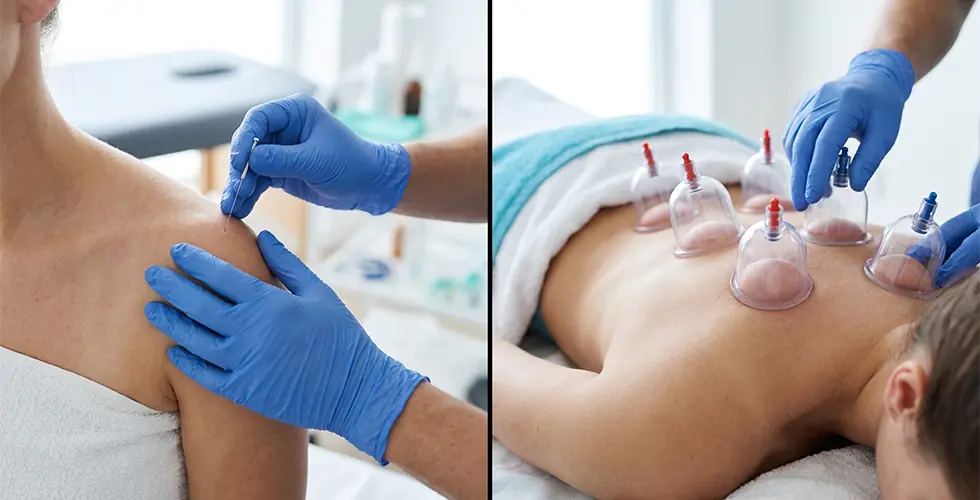
Dr. Ruz and Ms. Silvana are the main practitioners at Beyond Rehab clinic. Each practioner has a unique technique for dealing with trigger points and muscle tightness. Ms. Silvana Dehghan is the physiotherapist at the clinic and uses dry cupping and dry needling. She identifies the trigger point inside of the muscle and uses dry needling to create a mechanical stimulus. She then uses dry cupping around the area to lift the superficial fascia over the connective tissues. When dealing with musculoskeletal pain or muscle tension, you may encounter two common adjunct therapies in modern physiotherapy: dry needling and cupping. While both aim to manage pain and improve tissue mobility, their mechanisms are fundamentally opposite. Dry needling uses fine needles to penetrate the skin and target specific underlying tissues, whereas cupping uses negative pressure to pull the skin and superficial fascia outward.
Choosing the right modality depends entirely on a professional clinical assessment, your specific symptoms, and your overall rehabilitation goals. This guide breaks down the differences, the current scientific evidence, and how these treatments fit into a broader physical therapy plan.
What Is Dry Needling?
As a core offering in clinical rehabilitation, Dry Needling Services utilize thin, sterile filiform needles inserted through the skin to target specific musculoskeletal structures, often myofascial trigger points.
How Does Dry Needling Work?
Instead of injecting medication, the physical presence of the needle itself is the intervention. It is proposed that this targeted stimulation may help modulate pain signals and alter local tissue tension, sometimes eliciting a brief, involuntary muscle contraction known as a local twitch response.
Potential Benefits and Limitations
Current research suggests that dry needling may provide short-term benefits for managing certain musculoskeletal pain conditions. It is not a standalone cure, but rather a tool to temporarily reduce pain and improve range of motion so patients can engage more effectively in active exercise. For a deeper understanding of its mechanisms and applications, you can explore our detailed guide on What Is Dry Needling?.
How It Fits Into Physiotherapy
Physiotherapists utilize dry needling as an adjunct therapy. For instance, if muscle tension is limiting your neck mobility, a therapist might use this technique to reduce the pain before guiding you through strengthening exercises. You can learn more about this specific application in our article on Dry Needling for Neck Pain.
What Is Cupping Therapy?
Often integrated into comprehensive physical therapy plans through specialized Dry Cupping Services, this modality focuses on manipulating tissue from the surface rather than penetrating it.
How Does Dry Cupping Work?
The negative pressure lifts the skin and underlying superficial tissues into the cup. This creates a pulling sensation and may produce temporary changes in the local skin and soft tissues. However, the extent to which these effects contribute to meaningful pain relief or functional improvement remains uncertain.
Dry Cupping vs. Wet Cupping (Hijama)
It is important to distinguish between the two main types of cupping. Dry cupping relies solely on suction and does not break the skin. Wet cupping (Hijama) involves making superficial micro-incisions on the skin before applying suction to draw out small amounts of blood. In standard physiotherapy settings and for the scope of this guide, the focus is entirely on dry cupping.
Potential Benefits and Limitations
Dry cupping is often used with the intent to relieve superficial tissue tension and temporarily manage musculoskeletal discomfort. It is critical to note that claims suggesting cupping “detoxifies the body” or “flushes metabolic waste” lack robust scientific backing. The certainty of evidence supporting cupping for pain relief remains very low, and its primary value lies in short-term symptomatic relief as part of a comprehensive care plan.
Dry Needling vs. Cupping: Key Differences
| Feature | Dry Needling | Dry Cupping |
|---|---|---|
| Targeting & Application | Fine needle insertion targeting specific, localized underlying tissues and trigger points. | Suction/pulling applied to the skin to lift superficial fascia and broader muscle groups. |
| Patient Sensation | Potential for a brief local twitch response followed by a temporary deep ache. | A pulling, stretching, and sometimes tight sensation across the surface of the skin. |
| Common Side Effects | Temporary muscle soreness, minor bleeding, or localized bruising. | Circular skin discoloration (suction marks) and localized skin sensitivity. |
| Current Evidence | Research suggests potential short-term benefits for some musculoskeletal pain conditions, although results vary by condition and study quality. | Evidence for pain relief remains limited, and the certainty of available evidence is very low. |
Which Treatment May Be Appropriate for You?
A physiotherapist may consider dry needling when localized musculoskeletal pain or sensitivity is an appropriate target for the technique. Dry cupping may be considered when a patient prefers a non-needle approach and the therapist believes it is suitable for the presenting symptoms. Neither treatment is automatically the better option, and both should be selected based on clinical assessment, patient preferences, potential risks, and rehabilitation goals.
Can Dry Needling and Cupping Be Used Together?
Clinical Considerations
At Beyond Rehab clinic the clinical practice, physiotherapists sometimes use both modalities in a single session. The clinical rationale is to address different tissue layers: utilizing dry needling to target specific, deep focal points of tension, while applying dry cupping to mobilize the surrounding superficial fascia in the broader area.
What Does the Research Say?
While the combination is popular in practice, it is important to be objective about the science. Currently, high-quality direct evidence proving that the combination of dry needling and cupping is significantly superior to either treatment alone—or to standard active rehabilitation—is lacking. Studies showing the effectiveness of a comprehensive physical therapy plan should not be mistakenly cited as proof that combining these two specific passive therapies guarantees accelerated recovery. Decisions to combine them should be based strictly on individual patient assessment.
What to Expect During Treatment
Does Dry Needling Hurt?
Patients often feel a mild prick as the needle enters the skin. If the needle targets a sensitive trigger point, you may experience a local twitch response—a brief, involuntary muscle contraction that can feel like a quick cramp. Post-treatment soreness, similar to the ache felt after a heavy workout, is common and typically resolves within a day or two.
Do Cupping Marks Last?
Cupping can leave circular marks that resemble bruises. These marks result from the suction applied to the skin and may be accompanied by temporary tenderness or sensitivity. They usually fade gradually, but the time required varies depending on the individual and the intensity of the treatment.
How Many Sessions Might Be Needed?
There is no predetermined number of sessions for either therapy. The frequency and duration of treatment depend entirely on your specific condition, how your body responds to the initial interventions, and your overall active rehabilitation goals.
Safety, Precautions, and Aftercare
Potential Side Effects and Precautions
Both therapies carry distinct safety considerations that require a thorough clinical evaluation.
- Dry Needling: Requires precise anatomical knowledge to avoid underlying structures (such as nerves or lungs). Minor bleeding and localized soreness are the most common side effects. For a comprehensive breakdown of safety considerations, refer to our dedicated article on Dry Needling Side Effects.
- Dry Cupping: The most common side effects include skin discoloration, localized tenderness, and in rare cases, superficial skin irritation or blisters if the suction is too intense or left for too long.
Conditions such as bleeding disorders, the use of anticoagulant medications, active skin infections, and pregnancy require careful, individualized assessment. They are not automatic, absolute contraindications for both therapies across all patients, but rather critical factors that a physiotherapist must evaluate before deciding if either treatment is safe and appropriate for you.
Hygiene and Practitioner Qualifications
Safety is directly tied to the practitioner’s qualifications. Dry needling must be performed by a licensed physical therapist using single-use, sterile needles. Cupping equipment must be thoroughly sanitized between patients according to strict clinical hygiene protocols.
General Aftercare
Following either treatment, it is generally advised to stay hydrated and monitor the treated area. You may need to adjust the intensity of your workouts for 24 hours if you experience significant muscle soreness, but there are no rigid, universally applicable rules unless specifically directed by your therapist based on your unique health profile.
Frequently Asked Questions (FAQs)
Can These Treatments Replace Physiotherapy?
No. Both dry needling and cupping are passive adjunct therapies. They are designed to manage symptoms and create a window of opportunity for better movement. Long-term recovery, improved function, and injury prevention rely heavily on active physiotherapy, which includes load management, targeted strengthening, and movement re-education.
Next Steps in Your Rehabilitation
Dry needling and cupping offer entirely different mechanical approaches to managing musculoskeletal discomfort. While dry needling targets specific tissues with precision penetration, dry cupping relies on broad superficial suction. Neither is a magic cure, and the current scientific evidence highlights the need for realistic expectations regarding their short-term benefits.
The most effective approach is a highly individualized one. If you are dealing with chronic pain, muscle tension, or a sports injury, professional clinical assessment is the first step. Book a professional assessment at brehabdxb on Sheikh Zayed Road, Dubai, to determine how evidence-based therapies can safely integrate into your personalized rehabilitation plan.