
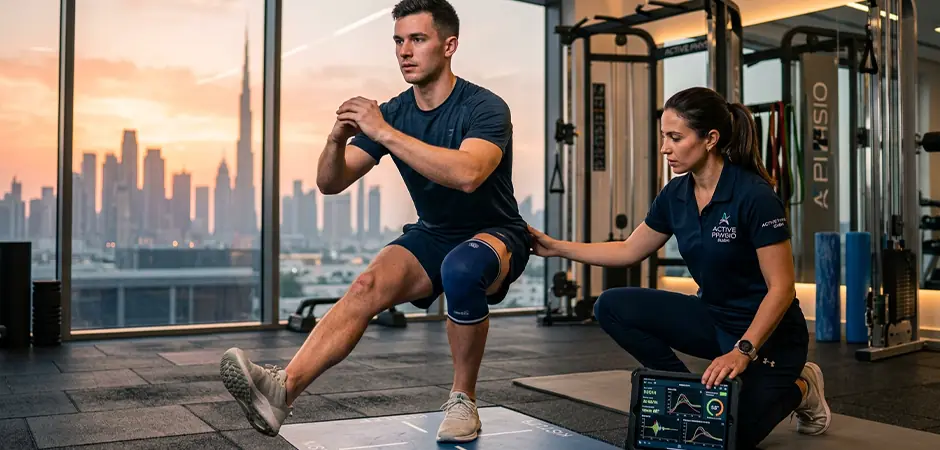
A criteria-based roadmap designed to help Dubai residents and athletes navigate their ACL recovery safely and return to sport with confidence.
Undergoing anterior cruciate ligament (ACL) reconstruction is a profound physical and psychological event. For residents embedded in Dubai’s vibrant and competitive sports community—whether participating in weekend padel tournaments, amateur football leagues, or endurance athletics—an ACL rupture often feels like a devastating setback. However, the surgical reconstruction of the ligament represents merely the first anatomical step toward reclaiming an active lifestyle. The true transformation, the process that dictates whether an individual returns to their pre-injury level of performance or suffers chronic joint instability, occurs entirely within the domain of rehabilitation.
Most ACL injuries occur through non-contact mechanisms, meaning there is no direct forceful collision between two athletes. Common mechanisms include sudden deceleration, cutting or pivoting, awkward landing, or rapid changes in direction.
ACL injuries are among the most common serious knee injuries in athletes, with well over 100,000 ACL injuries reported annually in the United States. Although the ACL is critical for maintaining anterior and rotational stability of the knee, not every ACL injury requires surgical reconstruction.
Management depends on factors such as the degree and type of ACL injury, knee stability, associated meniscal or cartilage injuries, the patient’s age, activity level, sporting demands, and functional goals. Some patients can achieve excellent outcomes with a structured rehabilitation program, while others particularly those with persistent instability or high-demand pivoting activities may be candidates for ACL reconstruction.
Clinical assessment includes orthopedic stability tests such as the Lachman test, anterior drawer test, and pivot-shift test. The posterior drawer and posterior Lachman-type assessments are primarily used to evaluate the PCL rather than the ACL. These tests should be interpreted together with the patient’s history, functional examination, and, when appropriate, MRI findings.
One important correction: “surgery is indicated for half of these cases and the other half is rehab” isn’t a reliable general rule. There isn’t a universal 50/50 split; the decision is individualized.
Also, if you’re discussing this in a professional presentation, I’d use “ACL reconstruction” rather than simply “ACL surgery,” because the usual surgical treatment for a torn ACL is reconstruction rather than repair.
Historically, postoperative recovery was dictated by rigid, time-based protocols, where patients were advanced to new exercises simply because a certain number of weeks had passed since their operation. Modern, high-quality physiotherapy after ACL surgery in Dubai has fundamentally shifted toward a criteria-based approach. This evidence-based paradigm, championed by leading global institutions like Aspetar, the UK’s National Health Service (NHS), and the biomechanical experts at E3 Rehab, mandates that a patient only progresses to the next phase of recovery when their knee has demonstrated specific physiological, neuromuscular, and biomechanical competencies.
Quick Timeline: Physiotherapy After ACL Surgery Dubai
To give you an immediate view of the recovery process, here is a breakdown of how a modern criteria-based rehabilitation program progresses across five distinct phases:
| Phase | Timeline | Primary Rehabilitation Goal |
|---|---|---|
| Phase 1 | 0–2 Weeks | Reduce swelling, protect the graft, and achieve full knee extension (“straightness”). |
| Phase 2 | 2–8 Weeks | Restore a normal walking gait without a limp and reach knee flexion >120°. |
| Phase 3 | 8–16 Weeks | Build significant quad/hamstring strength (Limb Symmetry Index ≥80%). |
| Phase 4 | 4–9 Months | Earn the right to run, master plyometric landing mechanics, and agility drills. |
| Phase 5 | 9–12+ Months | Sport-specific conditioning and full clearance via Return-to-Sport battery (LSI ≥90%). |
The Biological Foundation: Ligamentization and Graft Maturation
Before detailing the progressive phases of physical therapy, it is imperative to understand the underlying biological processes occurring within the knee joint. When an orthopedic surgeon reconstructs the ACL, they do not repair the torn ligament; they replace it with a graft. This graft is typically harvested from the patient’s own body (an autograft), most commonly utilizing the patellar tendon, the hamstring tendons, or the quadriceps tendon.
Once secured within the bone tunnels of the femur and tibia, the graft tissue undergoes a complex biological metamorphosis known as ligamentization. Initially, the harvested tendon is mechanically strong, but its native blood supply has been severed. During the first six to twelve weeks post-surgery, the graft enters a phase of avascular necrosis (cell death). The body’s immune system responds by initiating a massive revascularization process, slowly weaving a new capillary network into the dead tissue.
Counterintuitively, it is during this early remodeling phase—often when the patient is beginning to feel less pain and walk more normally—that the graft is at its weakest and most vulnerable to stretching or rupture. Over the subsequent months and years, the body repopulates the scaffold with fibroblasts, gradually remodeling the stiff tendon tissue to exhibit the viscoelastic properties of a native ligament. This maturation process can take upwards of 12 to 24 months to complete fully. Understanding this biological timeline is crucial because it underpins the rationale for every restriction, exercise, and clinical benchmark implemented by sports physiotherapists. Rushing the process outpaces biology, leading to a high probability of graft failure.
Phase 1: Protecting the Graft & Finding “Straight” (Weeks 0–2)
The initial two weeks post-surgery set the trajectory for the entire recovery timeline. According to guidelines from the NHS and E3 Rehab, this period is not a passive waiting game; it is an intensely active phase focused on combating the immediate trauma of the surgical intervention. The primary physiological enemies during this stage are joint effusion (swelling) and arthrofibrosis (joint stiffness).
The overriding clinical objectives are to reduce pain, control localized swelling using the RICE method (Rest, Ice, Compression, Elevation), and achieve full passive knee extension. Full extension means the operated leg can lay completely straight, matching the anatomical alignment of the uninjured limb.
The Rationale for Terminal Extension
Failing to achieve full terminal knee extension early in the rehabilitation process can result in catastrophic long-term consequences. A knee that cannot straighten fully alters the fundamental mechanics of the human gait cycle. Walking with a persistently bent knee places abnormal compressive forces on the patellofemoral joint (the kneecap), leading to chronic anterior knee pain, compensatory hip and lower back pathologies, and the potential development of cyclops lesions—a painful nodule of scar tissue that physically blocks the knee from straightening.
Overcoming Arthrogenic Muscle Inhibition (AMI)
Following joint trauma, the knee capsule fills with blood and synovial fluid. This swelling triggers a powerful neurological defense mechanism known as Arthrogenic Muscle Inhibition (AMI). The distension of the joint capsule stretches local mechanoreceptors, which send an inhibitory signal to the central nervous system, effectively “turning off” the quadriceps muscle. The brain prevents the muscle from contracting to protect the damaged joint, regardless of how intensely the patient concentrates. Consequently, managing effusion is an absolute prerequisite for restoring muscle function. As noted by E3 Rehab protocols, swelling and strength cannot be built simultaneously; the fluid must be evacuated before meaningful neuromuscular drive can be re-established.
Phase 1 Priority Exercises
| Exercise | Mechanism & Clinical Purpose |
|---|---|
| Ankle Pumps | Moving the foot upward and downward engages the calf muscle pump. This facilitates venous return, mitigating localized edema and significantly reducing the risk of deep vein thrombosis (DVT). |
| Quadriceps Sets (Quad Sets) | Isometric contractions where the patient attempts to push the back of the knee flat into the bed, holding for 5 seconds. This directly combats AMI by re-establishing the neural pathway between the motor cortex and the vastus medialis. |
| Heel Slides | Gently sliding the heel toward the glutes to initiate early knee flexion. The goal is to reach 90 degrees of flexion to prevent capsular contracture and nourish articular cartilage through movement. |
| Passive Extension Hangs | Propping the heel on an elevated surface while keeping the calf unsupported, allowing gravity to gently stretch the posterior joint capsule and hamstring tendons into terminal extension. |
Progression out of this initial phase is gated by strict criteria: the patient must present with full passive extension equal to the contralateral side, minimal joint effusion, and the ability to perform a single straight leg raise without any “extension lag” (the knee bending slightly as the leg lifts), proving that the quadriceps has been neurologically reactivated.
Phase 2: Walking and Early Movement (Weeks 2–8)
As the acute surgical pain subsides and the incisions heal, the rehabilitation focus shifts toward restoring the mechanics of daily life. The graft is entering its most vulnerable biological phase of necrosis and revascularization, meaning that mechanical protection remains paramount, but controlled loading is introduced to stimulate tissue alignment and muscle hypertrophy.
Gait Training and Weight Bearing
The primary functional milestones of Phase 2 are weaning off crutches, establishing a limp-free walking pattern, and achieving a knee flexion angle of at least 120 degrees. Physiotherapists place immense emphasis on gait training. Patients are instructed to practice a deliberate “heel-to-toe” walking pattern. The heel must strike the ground with the knee fully extended; weight is then transferred through the midfoot, culminating in a powerful push-off from the toes. Limping, or utilizing a “stiff-knee” gait, is a maladaptive compensation that must be corrected immediately to prevent secondary overuse injuries in the contralateral limb.
Managing Environmental Stressors in Dubai
In the context of the United Arab Emirates, managing daily activity levels during this phase requires specific environmental awareness. The intense heat of Dubai can exacerbate generalized vasodilation and dependent edema (swelling in the lower extremities). Patients who return to office work or attempt to rapidly increase their daily step count in high temperatures often experience a resurgence of knee effusion. Because effusion triggers AMI and shuts down the quadriceps, activity pacing and load modification are critical. Elevated resting postures and targeted compression therapy are heavily utilized to keep swelling at an absolute minimum.
Early Closed-Chain Strengthening
Strengthening during Phase 2 predominantly utilizes closed kinetic chain (CKC) exercises. In a CKC exercise, the distal aspect of the limb (the foot) is fixed against a solid surface, such as the floor or a wall. These movements co-contract the quadriceps and hamstrings, creating joint compression that stabilizes the tibia and minimizes anterior shear force on the fragile, healing ACL graft.
Early CKC loading begins with bodyweight wall slides and mini squats in a highly restricted range of motion (typically 0 to 60 degrees of knee flexion). These exercises load the quadriceps musculature without subjecting the patellofemoral joint to the extreme compressive forces associated with deep squatting. Once baseline motor control is established, patients progress to small step-ups and leg presses in protected ranges specified by their orthopedic surgeon.
Simultaneously, stationary cycling is introduced as soon as the knee can achieve approximately 100 to 110 degrees of flexion. Beginning with zero resistance, cycling is a cornerstone of early recovery. It promotes the circulation of synovial fluid, breaking down early scar tissue adhesions, and addresses the rapid decline in cardiovascular fitness that follows surgical immobilization.
Phase 3: The Strengthening Engine (Weeks 8–16)
Phase 3 is the foundational “mid-stage” of recovery, often described as the most arduous and physically demanding period of physiotherapy after ACL surgery in Dubai. By week eight, everyday activities like walking and navigating stairs generally feel normal, leading to a dangerous psychological illusion that the knee is fully healed. In reality, the limb suffers from profound muscular atrophy and lacks the protective “armor” required to stabilize the joint during dynamic movements.
The Persistent Strength Deficit & Limb Symmetry Index (LSI)
Modern clinical guidelines, spearheaded by extensive research from Aspetar and the biomechanical consensus of the E3 Rehab network, identify the absolute restoration of quadriceps and hamstring strength as the non-negotiable prerequisite for all subsequent athletic phases. Deficits in quadriceps strength are universally recognized as the single greatest predictor of a secondary knee injury following an ACL reconstruction.
To quantify this deficit, clinical specialists rely on the Limb Symmetry Index (LSI). The LSI calculates the strength of the surgically reconstructed leg as a percentage of the strength of the uninjured leg. A 1% increase in quadriceps LSI correlates with a 3% reduction in the risk of secondary injury. Before a patient is permitted to transition out of Phase 3 and begin any form of running or impact training, they must achieve an LSI of at least 80% on isolated strength metrics.
Overcoming the Open vs. Closed Chain Debate
To achieve these rigorous hypertrophy goals, rehabilitation protocols mimic structured strength and conditioning programs. A critical component of this phase involves the strategic use of open kinetic chain (OKC) exercises. Historically, many therapists avoided OKC exercises (such as the seated leg extension machine) out of fear that they applied excessive strain to the new ACL. However, contemporary biomechanical evidence confirms that OKC exercises, when implemented in safe ranges of motion, are unequivocally necessary to isolate and rebuild the quadriceps architecture. CKC exercises like squats allow the brain to “cheat” by shifting the mechanical load onto the glutes or the uninjured leg. Isolated leg extensions remove this compensatory capability, forcing the inhibited quadriceps to adapt and grow.
Core Phase 3 Exercises
| Exercise | Targeted Musculature & Biomechanical Focus |
|---|---|
| Squat Progressions | Transitioning from bodyweight squats to heavily weighted Goblet Squats. Develops bilateral force production and corrects weight-shifting asymmetries. |
| Seated Leg Extensions | Isolated OKC quadriceps hypertrophy. Counteracts chronic extensor mechanism deficits that persist if only compound movements are utilized. |
| Nordic Hamstring Curls | Supramaximal eccentric loading of the posterior chain. The hamstrings serve as the primary dynamic stabilizers of the ACL; eccentric strength prevents anterior tibial translation during deceleration. |
| Y-Balance Training | Standing on one leg while reaching the opposite foot in multiple directions. Retrains the central nervous system’s proprioceptive awareness of the joint in three-dimensional space. |
| Pallof Presses | Anti-rotation core stability. Weakness in the trunk frequently manifests as valgus collapse (inward bowing) at the knee. Core training anchors the pelvis to optimize lower limb mechanics. |
By the culmination of Phase 3, the patient must demonstrate zero reactive swelling following heavy resistance training, full and symmetrical range of motion, and substantial muscular hypertrophy to satisfy the criteria for impact loading.
Phase 4: Impact and Agility (Months 4–9)
The transition into Phase 4 marks the reintroduction of impact forces. This is a critical juncture where patients must strictly “earn the right” to run. The premature introduction of jogging—prior to satisfying the 80% strength criteria established in Phase 3—is a primary catalyst for graft elongation, chronic joint effusion, and ultimate surgical failure.
The Biomechanics of Return to Running
Running generates ground reaction forces equating to multiple times the individual’s body weight. If the quadriceps and calf muscles lack the capacity to absorb this force, the shock is transmitted directly into the articular cartilage and the healing ACL graft.
Initiating a return-to-run program in a clinical setting is highly structured. Patients do not arbitrarily begin jogging; they execute calculated walk/jog intervals (e.g., one minute of jogging followed by two minutes of walking) on predictable, controlled surfaces such as treadmills. Clinical specialists meticulously analyze running kinematics, monitoring stride length, cadence, and vertical oscillation to ensure the patient is not relying on a compensatory gait strategy to offload the surgical knee. The clinical response is monitored for 24 hours post-session; the absence of pain or swelling dictates the progression of running volume.
Plyometric Progressions and Motor Control
Concurrent with linear running, the neuromuscular system must be trained to handle explosive multidirectional forces. Plyometric training bridges the gap between raw gym strength and reactive athletic agility. The focus is entirely on the eccentric absorption of force (landing mechanics) before concentric force production (jumping).
The progression follows a strict hierarchy:
- Bilateral Jumping: Double-leg jumps onto an elevated box, prioritizing a “quiet,” soft landing that utilizes the hips, knees, and ankles as a synchronized shock-absorption system.
- Unilateral Jumping: Single-leg hops focusing on maintaining strict frontal-plane alignment (preventing the knee from collapsing inward).
- Deceleration Drills: In sports, ACL injuries rarely occur during maximal linear sprinting; they overwhelmingly occur during abrupt deceleration or rapid changes of direction. Training the body to apply the brakes safely is paramount.
- Agility and Change of Direction: Introducing pre-planned cone drills before advancing to chaotic, open-environment cognitive tasks where the athlete must react to an external stimulus (such as a ball or an opponent).
For plyometric progression and neuromuscular motor control, I recommend starting with simple, single-step jumps in multiple directions—lateral, forward, and backward. The primary focus should be on controlled movement and a soft, quiet landing rather than maximal distance or height. During landing, the athlete should maintain good lower-limb alignment, particularly controlling excessive dynamic knee valgus and unwanted femoral internal rotation.
The progression should prioritize quality of movement, knee stability, and the ability to absorb and control load before increasing jump distance, speed, complexity, or adding multidirectional and reactive components.
One small terminology point: rather than saying “without internal rotation of the hip,” I’d say “controlling excessive femoral internal rotation and knee valgus.” Some hip internal rotation is normal; the concern is excessive or poorly controlled rotation associated with dynamic knee valgus.
A simple progression could be:
- Single-step
- Bilateral landing
- Single-leg landing
- Multidirectional
- Reactive
- Sport-specific
And throughout: land softly → stabilize → control alignment → then progress speed and complexity.
Phase 5: Return to Sport Clearance (Months 9–12+)
The final phase addresses the ultimate objective: a safe, confident return to competitive play. In Dubai’s sports-centric environment, where residents are highly engaged in high-risk pivoting sports like padel, football, and rugby, athletes frequently experience intense psychological pressure to expedite this timeline. However, biological reality dictates otherwise. The ACL graft can require up to two years to fully mature into a ligament, and clinical data explicitly demonstrates that delaying return to sport significantly reduces reinjury risk up to the nine-month mark.
Clinical Benchmarks for Clearance
The decision to clear an athlete for unrestricted competition is never determined by time alone. Leading sports medicine frameworks, such as the Aspetar Clinical Practice Guidelines, mandate the successful completion of a rigorous, multifaceted testing battery.
To achieve medical clearance, the athlete must satisfy the following strict criteria:
- Isokinetic Strength Symmetry: An LSI of 90% or higher for both quadriceps and hamstring torque production, measured objectively across various angular velocities.
- Functional Hop Tests: The patient must achieve an LSI of ≥90% across a battery of functional tests, including the single hop for distance, the triple hop for distance, the crossover hop, and the 6-meter timed hop, while demonstrating flawless landing kinematics.
- Symptom Resolution: Absolute absence of pain, joint effusion, or subjective feelings of instability during or after intense, sport-specific conditioning.
- Psychological Readiness: The psychological trauma of an ACL rupture often results in kinesiophobia (fear of movement). Objective psychometric tools, such as the ACL-RSI (Return to Sport After Injury) index, are utilized to quantify the athlete’s confidence in their knee. Fear and hesitation alter biomechanics on the field, drastically increasing the risk of both ipsilateral (same knee) and contralateral (opposite knee) ruptures.
Gradual Re-entry into Competition
Returning to sport is a progressive dial, not an instantaneous switch. Once cleared, athletes execute a gradual re-entry protocol. They begin with non-contact technical training, progress to controlled contact drills, transition into partial match play with restricted minutes, and finally achieve full, unrestricted competitive participation.
Advanced Technologies for Physiotherapy After ACL Surgery in Dubai
One of the defining advantages of undergoing physiotherapy after ACL surgery in Dubai is the availability of world-class, elite-level sports science technology. Specialized clinics in the region employ sophisticated diagnostic and therapeutic equipment to remove subjectivity from the rehabilitation process.
| Technology | Clinical Application in ACL Rehabilitation |
|---|---|
| Isokinetic Dynamometry (e.g., Biodex) | Considered the global gold standard for objective muscle testing. These robotic systems provide accommodating resistance throughout the entire range of motion, accurately measuring torque, power, and precise LSI deficits that manual human testing cannot detect. |
| Dual Force Plates | Utilized during jump and hop testing to analyze ground reaction forces. They measure Rate of Force Development (RFD) and detect microscopic asymmetries in how an athlete absorbs weight between their injured and uninjured limbs upon landing. |
| Anti-Gravity Treadmills (AlterG) | Employing differential air pressure technology, these treadmills effectively unweight the patient. This allows for the normalization of running mechanics and cardiovascular conditioning weeks before the knee can tolerate full gravitational impact. |
| Kineo & Elastic Biofeedback | Advanced robotic pulley systems that offer precise load management. They allow for heavy eccentric overloading and elastic biofeedback, stimulating 20-30% faster muscle activation without causing excessive joint shear. |
Strategic Tips for Success in the UAE
Successfully navigating a comprehensive 12-month rehabilitation protocol requires intense personal dedication that extends far beyond the walls of the physiotherapy clinic. Several lifestyle and environmental variables uniquely impact recovery in the UAE.
Consistency and Adherence
The foremost reason for suboptimal surgical outcomes, chronic weakness, or reinjury is a lack of adherence to the prescribed rehabilitation protocol. Physiotherapy must become integrated into the patient’s daily lifestyle. Missing scheduled clinical sessions or failing to execute independent gym-based strength programs guarantees that the critical muscular armor will remain deficient.
Hydration and Nutritional Optimization
The extreme climate of the UAE places a high metabolic and hydrational demand on the body. Chronic dehydration negatively alters the viscoelastic properties of joint cartilage, fascia, and connective tissues, increasing friction within the healing joint. Furthermore, the massive muscle hypertrophy required during Phases 3 and 4 is biologically impossible without a sustained caloric surplus and optimal protein synthesis. Athletes must prioritize a high-protein diet to provide the amino acid building blocks necessary for tissue repair.
Decoding “Good” vs. “Bad” Pain
During aggressive rehabilitation, distinguishing between adaptive and destructive pain is vital to avoid setbacks.
- Adaptive (Good) Pain: Delayed onset muscle soreness (DOMS), characterized by a dull, generalized ache (e.g., a 4/10 on the pain scale) in the quadriceps, hamstrings, or glutes, is a normal, necessary physiological adaptation to progressive strength loading.
- Destructive (Bad) Pain: Conversely, sharp, localized, stabbing pain deep within the joint space, a sudden onset of visual effusion, or pain that progressively worsens during an exercise and alters the walking gait are critical warning signals. These indicate that the joint structures are being overloaded beyond their current tensile capacity, requiring immediate cessation of the activity and consultation with the clinical specialist.
Recovering from ACL surgery requires expert guidance at every stage. At Beyond Rehab Dubai, our physiotherapists create individualized, criteria-based rehabilitation programs using evidence-based protocols and advanced assessment technology to help you return to sport safely.