
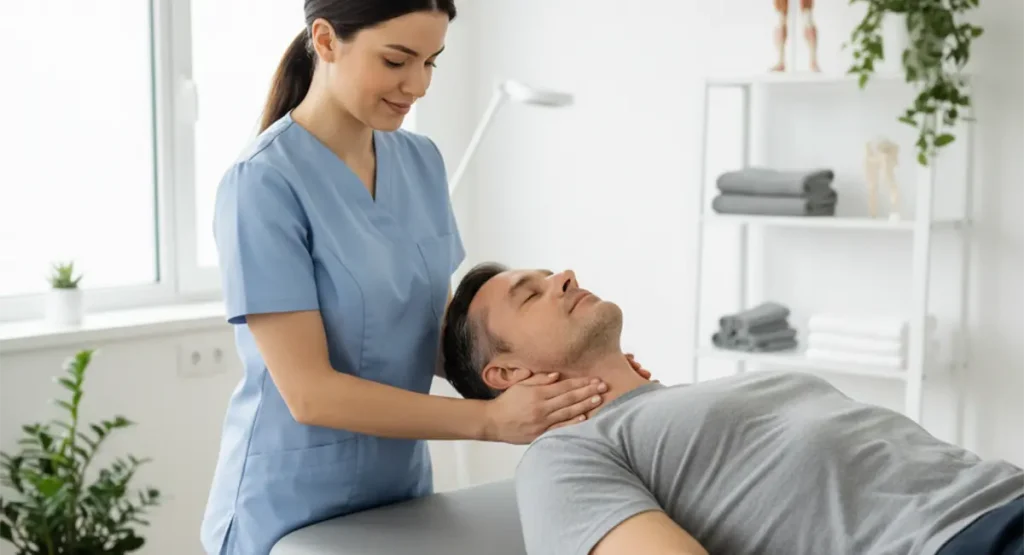
Neck pain is a widespread issue that can seriously disrupt your daily life. Fortunately, physical therapy stands out as one of the most effective ways to find long-term relief. It plays a vital role in easing pain, reducing muscle stiffness, and bringing back your neck’s natural movement. At Beyond Rehab, we know that every person is unique. That is why we customize your treatment plan specifically to your condition to ensure you get the best possible results.
Understanding Neck Pain: Clinical Anatomy, Causes, and Global Burden
Your neck (the cervical spine) is an incredibly complex structure made up of seven small bones called vertebrae, numbered C1 to C7. It holds up your head—which weighs about 10 to 12 pounds—while letting you turn and tilt it easily. Because the neck is so flexible, it is highly prone to everyday strains, minor injuries, and natural wear and tear. When the neck’s joints, discs, ligaments, or muscles get damaged, they can easily pinch nearby nerve roots. This nerve compression causes sharp, shooting pain to travel down your shoulder, shoulder blade, and arm—a medical condition known as Cervical Radiculopathy.
Global health data shows that neck pain affects around 3% of the world’s population every year. According to the Global Burden of Disease studies, neck problems are a leading cause of disability worldwide, ranking 19th in Years Lived with Disability (YLDs) and 4th in overall health loss (DALYs). This condition makes simple daily activities—like driving, working at a computer, playing sports, or getting a good night’s sleep—incredibly difficult, leading to major healthcare expenses and lost productivity globally.
What Are the Most Common Causes of Neck Pain?
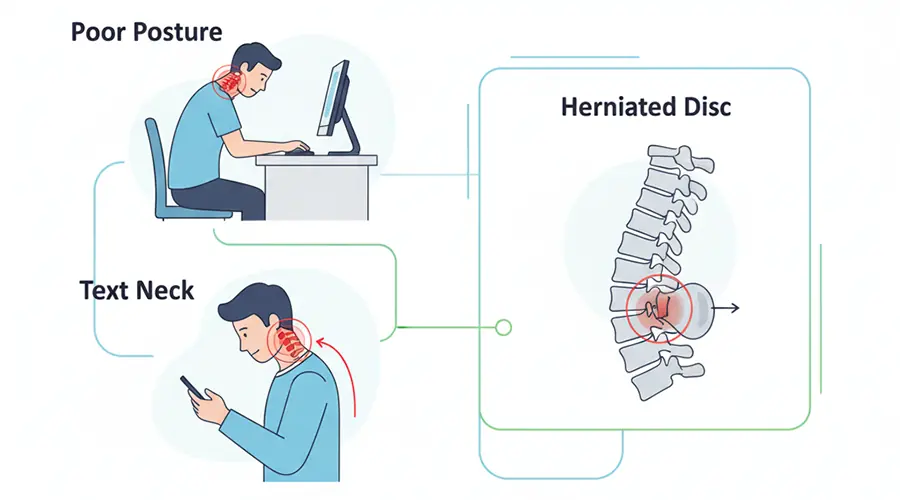
Learning about the Most Common Causes of Neck Pain is your first step toward recovery. While the exact trigger can vary from person to person, most neck pain comes from daily habits, sudden injuries, or gradual wear and tear:
- Poor Desk Setup & Posture: Sitting at a computer for hours, looking down at your phone (“text neck”), or sleeping on an unsupportive pillow.
- Repetitive Neck Movements: Jobs or sports that require you to constantly turn your head or hold your neck in a bent position.
- Sudden Injuries: Sports impacts, unexpected falls, or car accidents that cause whiplash.
- Spine Wear and Tear: Age-related changes like cervical osteoarthritis (worn-out joints), herniated or slipped discs, and spinal stenosis (narrowing of the spinal canal).
- Hidden Medical Issues: Rare but serious conditions like infections, localized tumors, or spinal fractures that need immediate medical checking.
Comparative Analysis: Physical Therapy vs. Surgical and Pharmacological Approaches
When dealing with neck pain, choosing the right treatment early is crucial to prevent a temporary issue from becoming a long-term problem. High-quality medical reviews and clinical trials have compared conservative physical therapy against medications and surgery to see what works best over time:
- The Risks and Limits of Pain Medications: Common anti-inflammatory drugs (NSAIDs) and muscle relaxants (like tizanidine) only provide temporary, short-term relief for muscle spasms and swelling. More importantly, clinical trials show that powerful prescription opioids do not reduce acute neck pain any better than a placebo (a dummy pill), but they dramatically increase your risk of side effects like drowsiness, constipation, and dependency. On the other hand, hands-on physical therapy naturally calms irritated nerves and triggers your body’s built-in pain-relief systems, making it a much safer and long-lasting choice.
- The Reality of Neck Surgery: For most people with ongoing neck pain—unless they have severe nerve damage like muscle wasting or loss of reflexes—surgery is rarely better than hands-on therapy. Major medical reviews show that invasive surgeries, such as neck fusions (ACDF), do not deliver better long-term pain relief or movement scores than a specialized, structured physical therapy program. Surgery also comes with clear risks, including anesthesia problems, infections, and accelerated wear on the surrounding spine joints. Furthermore, patients who experience high anxiety or worry intensely about their pain often find that surgery fails to provide the relief they expected.
- Why Combined Physical Therapy Works Best: Strong clinical evidence proves that a combined approach works wonders. Pairing hands-on therapy (gentle joint movements and adjustments of the neck and upper back) with targeted exercises significantly lowers pain, dramatically improves daily function scores, and restores your natural range of motion. By treating the actual physical root cause of your pain rather than just hiding the symptoms temporarily, physical therapy builds long-term stability in your spine.
Clinical Goals and Classification Based on High-Level Guidelines (APTA Framework)
Our main goal in physical therapy is not just to give you quick relief, but to improve your overall quality of life using proven, scientific methods. Your first visit starts with a thorough evaluation where we look at when your pain started, how it changes throughout the day, past injuries, and factors that might delay your recovery (such as being over 40, having lower back pain, weaker grip strength, or experiencing stress and anxiety). We use standardized tracking tools, like the Neck Disability Index (NDI) and the Visual Analog Scale (VAS), to measure exactly how much your pain limits you and to track your objective progress across every session.
The comprehensive table below breaks down the clinical types of neck pain and the specific treatment plans for each stage of recovery, fully aligned with the official guidelines of the American Physical Therapy Association (APTA) under the ICF framework:
| ICF Classification Group | Key Diagnostic Criteria & Symptoms | Acute Phase Interventions | Subacute Phase Interventions | Chronic Phase Interventions |
|---|---|---|---|---|
| Neck Pain with Mobility Deficits | One-sided neck pain, stiff or limited movement (ROM), pain when fully turning or tilting, and stiff spine joints in the neck or upper back. | Upper back adjustments, neck movement exercises, shoulder blade strengthening, gentle neck joint mobilization. | Endurance exercises for the neck and shoulders, upper back adjustments, and gentle neck joint mobilization. | Combined approach: Neck and upper back adjustments, muscle coordination exercises, dry needling, laser therapy, and mechanical neck traction. |
| Neck Pain with Movement Coordination Impairments | Past neck strain or whiplash (WAD), tension headaches, weakness in the deep front neck muscles, or pain radiating into the arm. | Guidance on moving safely early on, avoiding long-term use of soft neck collars, and gentle posture correction exercises. | Hands-on joint mobilization paired with gentle, progressive exercises (for endurance, flexibility, and coordination) and stress-management strategies. | Patient guidance, lifestyle advice, progressive neck and upper back exercises to build strength safely, and TENS therapy for pain relief. |
| Neck Pain with Headaches (Cervicogenic) | One-sided, dull headache that starts in the neck and gets worse with certain head movements or pressure at the base of the skull. | Patient guidance, active neck movement exercises, and targeted self-stretching techniques (C1-C2 Self-SNAG) using a strap. | Professional neck adjustments and gentle joint mobilization, along with C1-C2 Self-SNAG home exercises. | Neck and upper back adjustments combined with stretching, plus endurance training for the deep front neck muscles and shoulders. |
| Neck Pain with Radiating Pain | Sharp, shooting, or burning pain, numbness, tingling in specific arm areas, and positive nerve tension tests (ULNT). | Gentle nerve-gliding movements, neck stabilizing exercises, laser therapy, and very limited/short-term use of a soft collar. | Progressive stretching and strengthening, improving joint stability and movement, and education on proper posture and biomechanics. | Intermittent mechanical neck traction, paired with stretching, targeted strengthening, and neck/upper back adjustments. |
Pathophysiology and Re-education Protocols for the Deep Cervical Flexors (DCF)
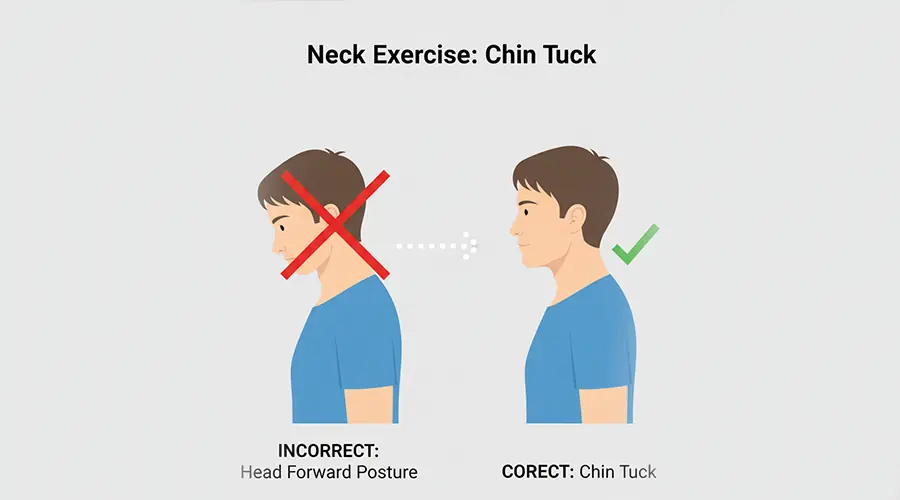
Your Deep Cervical Flexors (DCF)—specifically the Longus Colli and Longus Capitis muscles—act as the inner “core” stabilizers of your neck. They keep your neck in its natural, healthy curve and protect the spine from unneeded stress. When someone suffers from ongoing or mechanical neck pain, these deep muscles essentially “shut down” or become weak. This leads to fast muscle fatigue, forcing the body to compensate by poking the chin forward—a common issue known as Forward Head Posture (FHP).
This unbalanced posture massively increases the strain on your large outer muscles, like the Sternocleidomastoid (SCM) at the side of the neck and the Upper Trapezius across the shoulders. Over time, these outer muscles work overtime to keep your head up, causing them to become tight, overworked, and deprived of good blood flow. This creates a painful cycle of tight muscle knots (trigger points) and constant, painful muscle spasms.
The Pressure Biofeedback Unit (PBU) Re-education Protocol
Using a specialized tool called a Pressure Biofeedback Unit (PBU) is the absolute gold standard for retraining and re-activating these deep neck stabilizer muscles. This precise training stimulates the dense network of nerve receptors at the base of your skull, helping quickly restore your brain’s control over your neck movements, balance, and coordination.
- Starting Position: You lie flat on your back with your knees bent. An uninflated PBU air cushion is placed right under the natural curve of your neck and inflated to a starting pressure of 20 mmHg.
- The Movement (The Chin Tuck): You perform a very gentle, slow head-nodding motion (like nodding “yes”) without tensing the big outer neck or shoulder muscles. The goal is to slightly flatten your neck curve, which smoothly pushes down on the cushion and raises the pressure on the gauge.
- Progressive Pressure Steps: You will try to reach 5 distinct, consecutive pressure levels, moving up by 2 units at a time: 22, 24, 26, 28, and finally 30 mmHg.
- Reps and Sets: You must hold each pressure level completely steady for 10 seconds without shaking, holding your breath, or cheating with outer muscles. The full clinical routine involves 3 sets of 10 repetitions, done 4 days a week for 4 weeks straight.
Clinical Deep Cervical Flexor Endurance Testing
To easily measure your neck muscle endurance without fancy gear, we use the Deep Cervical Flexor Endurance Test:
You lie on your back with your knees bent and perform a full chin tuck. While holding this position, you lift your head about 2.5 centimeters (1 inch) off the treatment table. Your physical therapist will track the time with a stopwatch and stop it the exact moment your form slips or your head drops. On average, healthy individuals without neck pain can hold this for about 29 seconds for females and 39 seconds for males. If your time is significantly lower, it is a direct sign of weak stabilizing muscles linked to chronic neck pain and coordination issues.
In addition, clinical research shows that using specific movements from the famous McKenzie Method (which uses repeated neck tucks and backward bending) is incredibly effective for calming irritated nerves and restoring your neck’s natural curve, often providing much better long-term relief than basic static exercises.
Clinical Management of Cervicogenic Headaches (CGH)
A Cervicogenic Headache (CGH) is a type of headache that actually originates from joint stiffness or muscle problems in the top three segments of your neck (C1, C2, and C3). The reason this happens is due to a fascinating wiring crossover in your nervous system called sensory convergence inside the Trigeminocervical Complex. Think of it like a busy telephone central station where pain signals from your top neck joints mix with sensory nerves from your face and forehead. Because of this mix-up, your brain misinterprets the neck problem as a headache around your forehead, eyes, or temples.
Recent high-level medical reviews prove that combining different physical therapy treatments works far better than relying on a single passive treatment (like just getting a massage or taking a pill). The table below outlines how effective different therapy combinations are at reducing headache pain and frequency:
| Combined Clinical Intervention | Pain Intensity Reduction (Mean Difference – MD) | Headache Frequency Reduction (Monthly MD) | Impact on Headache Impact Test (HIT-6) |
|---|---|---|---|
| Cervical Manual Therapy + Dry Needling | -5.98 (Highest Statistical Efficacy) | -15.29 days per month | Brings incredible, deep clinical relief and improvement. |
| Cervical Manual Therapy + Active Exercise Training | -3.01 to -4.87 | -3.09 days per month | Provides great, long-lasting improvements to your quality of life. |
| Muscle Energy Techniques (MET) + Standard Exercise | -4.37 | Data Unavailable | Effectively unlocks stiff neck joints and improves movement. |
| Passive Monotherapies (Isolated Massage or Medication) | Very Limited Efficacy | No Significant Change | Fails to provide any lasting, long-term relief. |
Simple self-stretching methods you can do yourself—like the C1-C2 Self-SNAG technique using a specialized exercise strap or towel—have strong scientific proof for calming down sudden headache flare-ups instantly. To get permanent relief and stop the headaches from coming back, we combine these quick exercises with personalized adjustments to your daily desk setup.
Clinical Management of Cervical Radiculopathy & Neurodynamic Mobilization
Cervical Radiculopathy happens when a nerve root leaving your neck spine gets pinched or irritated, usually from a herniated (slipped) disc or age-related spine wear and tear (cervical spondylosis). It affects up to 179 out of every 100,000 people each year and is a major cause of long-term nerve and muscle pain down the arm.
Modern clinical trials show that adding a specialized technique called Neurodynamic Mobilization (nerve gliding) to standard physical therapy provides incredible results:
- How It Works: Nerve-gliding techniques use gentle, precise movements to slide and stretch your nerves safely through their natural pathways. This movement helps gently break loose tight scar tissue around the nerve, boosts healthy local blood flow, and drains away fluid buildup or swelling inside the irritated nerve.
- The Scientific Proof: Combining gentle neck joint adjustments with these targeted nerve-gliding exercises leads to a rapid reduction in severe pain compared to just taking medication or resting. Studies show an average pain drop of -3.23 on the Visual Analog Scale, alongside a massive boost in arm function and strength.
- Mechanical Neck Traction: For patients with stubborn, ongoing arm pain, using a gentle mechanical traction device along with stabilizing exercises helps temporarily create space between the neck bones. This gentle decompression takes the pressure right off the pinched nerve root, offering instant relief and helping the tissue heal faster.
Vascular Screening and Patient Safety: The International IFOMPT Framework
Your safety is the absolute foundation of professional physical therapy. Before performing any hands-on adjustments or deep joint movements on your neck, a thorough circulation check is mandatory. Following the strict safety rules of the International Federation of Orthopaedic Manipulative Physical Therapists (IFOMPT), physical therapists must screen for any hidden neck circulation issues, known as Cervical Arterial Dysfunction (CAD). Checking this ensures there are absolutely no underlying blood vessel weaknesses, keeping your treatment 100% safe and avoiding any rare risks to the main neck arteries.
The “5Ds and 3Ns” Diagnostic Screening Matrix
During your initial consult and physical exam, your therapist will look out for a specific checklist of warning signs known globally as the “5Ds and 3Ns”. These red flags help us ensure your blood flow is perfectly healthy before we begin hands-on treatment:
| Key Vascular Red Flags (5Ds & 3Ns) | Arterial Risk Predictors & Co-morbidities | Clinical Decision-Making & Shared Care (AHRQ SHARE) |
|---|---|---|
| 1. Dizziness / Vertigo 2. Diplopia (Double vision) 3. Dysphagia (Difficulty swallowing) 4. Dysarthria (Difficulty speaking) 5. Drop Attacks (Sudden fainting) 6. Nausea / Vomiting 7. Nystagmus (Involuntary eye movement) 8. Numbness (Unilateral facial paresthesia) |
• Uncontrolled high blood pressure or high cholesterol. • History of sudden, unusual or atypical migraines. • Recent minor injury or bump to the neck or head. • Connective tissue conditions (like Rheumatoid Arthritis or loose joints) that affect neck ligament stability. • A personal or family history of early strokes or heart issues. |
1. Involve You Fully: We clearly explain all hands-on treatment options and answer any questions about benefits or rare risks. 2. Compare Options: Together, we weigh the great functional benefits of hands-on mobilization against alternative choices. 3. Respect Your Preferences: We make sure you are completely comfortable and satisfied with the chosen treatment plan. 4. Make a Joint Decision: We select the safest, most effective, scientifically-proven joint techniques with your full agreement. 5. Monitor Progress: We continuously track how your nerves and blood flow respond during and immediately after care. |
If even a single one of these warning signs is present, your physical therapist will immediately avoid deep neck adjustments and seamlessly coordinate with medical specialists or imaging centers to run quick scans (like an MRA or CTA) to put your safety first.
Workstation Ergonomics and the Biomechanics of “Text Neck” Syndrome
With everyone using smartphones, tablets, and sitting at computers all day, an issue called Text Neck Syndrome has become a global epidemic. This modern problem happens when you spend hours looking down at screens, forcing your head forward out of its natural alignment.
The Logarithmic Distribution of Mechanical Force on the Cervical Spine
When your head sits perfectly straight (0 degrees of tilt), it weighs about 10 to 12 pounds, which your neck handles easily. However, as you tilt your head forward to look at a screen, the physical weight and crushing pressure on your neck spine increase dramatically:
- 15 Degrees Forward: The weight your neck has to hold up jumps to 27 pounds.
- 30 Degrees Forward: The pressure on your neck spine reaches 40 pounds.
- 60 Degrees Forward (The exact angle most people use when texting with a phone in their lap): Your neck is forced to hold up a staggering 60 pounds (27 kilograms)!
This constant, heavy overloading overstretches the ligaments supporting your spine, causes the small muscles at the base of your skull to become painfully tight, and massively increases the pressure inside your spinal discs. Over time, this pressure accelerates herniated (slipped) discs and triggers early bone spurs (cervical spondylosis).

Ergonomic Station Specifications (OSHA and Physical Therapy Standards)
To permanently fix these repetitive daily stresses, setting up a proper ergonomic workstation is your best defense against neck fatigue. The following guidelines align directly with international OSHA standards and professional physical therapy protocols:
| Workstation Component | Technical Specifications & Mechanical Adjustments | Biomechanical Consequences of Improper Setup |
|---|---|---|
| Monitor Height & Distance | The top edge of your screen should line up right at or 2 to 4 inches below your direct eye level. Keep it about an arm’s length away (50 to 65 cm), with your gaze resting slightly downward at a 15 to 20-degree angle. | A monitor that is too low forces your neck to constantly bend forward. A screen placed too far away makes you lean and poke your chin forward, causing severe Forward Head Posture. |
| Lumbar Backrest Support | Your chair must actively support the natural curve of your lower back. Using a slightly wedged seat cushion helps tilt your pelvis forward, keeping your hips a bit higher than your knees to naturally support your whole spine. | Without lower back support, you will naturally slouch your upper back. This slouching automatically forces your upper neck to tilt far backward just to keep your eyes looking straight ahead, causing severe compression. |
| Seat Height & Leg Position | Adjust your chair height so both feet rest completely flat on the floor, with your thighs parallel to the ground (knees bent at a comfortable 90 to 100-degree angle). Use a footrest if your desk is too high and cannot be adjusted. | Letting your feet dangle reduces leg circulation and causes you to slide forward. This completely ruins your back support, shifting a massive amount of compensatory strain right up into your neck muscles. |
| Armrest & Elbow Placement | Adjust your armrests so your elbows rest comfortably at a 90 to 120-degree angle. This allows your shoulders to stay completely dropped, relaxed, and neutral, with your upper arms resting close to your sides. | Armrests that are too high push your shoulders up, causing the muscles across your shoulders and neck to constantly tense up. This chronic muscle tension directly leads to severe neck strain and tension headaches. |