
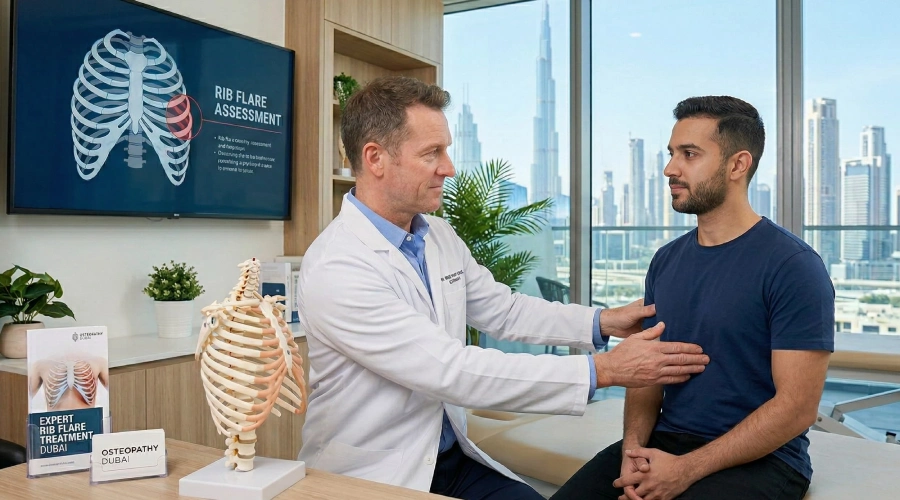
Overcome chronic back pain, “tech neck,” sports injuries, and postural strain with Dubai’s premier multidisciplinary clinic. Reclaim your mobility, live pain-free, and optimize your physical performance today.
Book Your Comprehensive Assessment Now
Executive Overview
Rib flare, a highly prevalent yet frequently mischaracterized biomechanical asymmetry, manifests clinically when the lower ribcage protrudes anteriorly and superiorly, disrupting the anatomical neutrality of the thorax, spine, and pelvis. While historically dismissed by some clinical practitioners as a purely aesthetic anomaly, contemporary biomechanical and neurological research confirms that unmanaged rib flare initiates a cascade of systemic physiological dysfunctions. These dysfunctions encompass chronic lumbar and cervical pain, pelvic floor instability, respiratory inefficiency, and profound vagal nerve suppression leading to gastrointestinal distress.
This exhaustive research document provides a multidimensional, expert-level analysis of rib flare etiology, pathophysiological consequences, and advanced non-surgical interventions. The clinical analysis synthesizes protocols from the Postural Restoration Institute (PRI), targeted physiotherapy, specialized chiropractic adjustments, and myofascial dry needling, providing a complete rehabilitation framework. Furthermore, acknowledging the fiercely competitive healthcare landscape in the United Arab Emirates, this document transitions into a robust Search Engine Optimization (SEO) blueprint. This digital strategy is explicitly designed to capture high-intent organic traffic for physical rehabilitation clinics operating in Dubai, transforming clinical expertise into measurable patient acquisition.
Anatomical and Biomechanical Foundations of the Thoracic Cage
The human ribcage serves as the foundational scaffolding for respiratory mechanics, vital organ protection, and the transfer of kinetic energy between the upper and lower extremities. Understanding the mechanics of rib flare requires a precise examination of thoracic anatomy. The ribcage consists of true ribs, false ribs, and floating ribs. The lower ribs, specifically ribs eight through ten (the “false ribs”), do not attach directly to the sternum. Instead, they converge via a highly flexible cartilaginous matrix to form the costal margin.
This inherent flexibility in the cartilaginous attachments is evolutionary and crucial for multi-directional respiratory expansion. However, it simultaneously leaves the lower anterior thorax highly susceptible to compensatory positioning. Because these lower ribs are not directly anchored to the sternal bone, any alteration in the resting tension of the surrounding musculature—such as the external obliques, transversus abdominis, or the diaphragm—can cause these ribs to migrate outward and upward, creating the visible “flare”. Under normal physiological conditions, the right and left sides of the ribcage should appear symmetrical, moving synchronously like bucket handles during the inhalation and exhalation cycles. When a flare is present, this synchronous bucket-handle motion is disrupted, fundamentally altering human movement patterns.
The Zone of Apposition (ZOA) and Diaphragmatic Mechanics
Central to the clinical understanding and rehabilitation of rib flare is the Zone of Apposition (ZOA), a biomechanical concept championed by the Postural Restoration Institute (PRI). The ZOA is anatomically defined as the cylindrical aspect of the diaphragm that apposes the inner aspect of the lower mediastinal wall. Its region extends from the diaphragm’s caudal insertion near the costal margin, cephalad to the costophrenic angle, where the muscle fibers eventually break away from the inner rib cage to form the free, unattached diaphragmatic dome.
Under optimal physiological conditions, a properly aligned dome-shaped diaphragm maintains a substantial ZOA, accounting for more than one-half of the total surface area of the internal rib cage at residual lung volume, and representing roughly one-fourth to one-third of the total surface area during quiet, upright breathing. The structural integrity of the ZOA is paramount because it dictates the diaphragm’s mechanical advantage. It is controlled heavily by the resting tension of the abdominal and oblique muscles, which direct diaphragmatic tension downward to create negative intra-thoracic pressure.
However, individuals presenting with elevated, anteriorly, and externally rotated ribs (rib flare) suffer an immediate and profound decrease in their ZOA. As the ribs flare, the diaphragm loses its dome shape and becomes pathologically flattened. A flattened diaphragm is mechanically disadvantaged; it has significantly less excursion capacity, meaning it cannot drop efficiently to draw air into the lower lobes of the lungs. Because the biological demand for oxygen remains constant, the central nervous system must compensate for this diaphragmatic failure. It do so by recruiting secondary respiratory muscles—primarily the sternocleidomastoid (SCM), upper trapezius, and scalenes—to elevate the entire upper chest wall to bring air into the lungs. This chronic accessory muscle overuse is a direct consequence of a diminished ZOA and is the primary driver of the chronic neck and shoulder tension frequently observed in patients with flared lower ribs.
Furthermore, PRI literature emphasizes that ZOA dysfunction is frequently asymmetrical, often presenting more severely on the left side due to inherent human anatomical asymmetries (such as the placement of the liver on the right, which supports the right hemidiaphragm). Achieving a proper ZOA, particularly on the left side, is thus an essential and non-negotiable objective of comprehensive postural restoration programs.
Comprehensive Etiology of Ribcage Asymmetry
Rib flare is rarely an isolated, idiopathic phenomenon; rather, it is a global biomechanical strategy utilized by the nervous system to manage gravity, force absorption, and structural deficits across the kinetic chain. The clinical presentation is typically driven by one or a complex combination of the following physiological etiologies:
Postural and Kinematic Compensations
Chronic sedentary behavior and prolonged sitting frequently result in the deterioration and lengthening of the anterior core musculature. In individuals who spend extended periods in a seated, slouched position, the deep stabilizing muscles—particularly the external obliques and transversus abdominis—experience a loss of resting tonus. Without the necessary downward muscular tension provided by the obliques to anchor the lower ribcage inferiorly, the flexible costal cartilages allow the ribs to flare outward and upward.
Furthermore, rib flare is highly correlated with global postural deviations, most notably an anterior pelvic tilt. When an individual adopts a posture characterized by locked, hyperextended knees, the pelvis is driven anteriorly. To prevent the body from falling forward and to maintain a horizontal visual gaze, the central nervous system commands the upper body to lean backward. This creates a compensatory spinal extension in the thoracolumbar junction, pushing the chest out and forcing the lower ribcage into a prominent flared position. In this scenario, the rib flare is merely a systemic adaptation to a lack of motion and stability at the feet, knees, and hips.
Postpartum Structural Adaptations and Diastasis Recti
Pregnancy introduces some of the most profound and rapid structural modifications the human body can experience. As the fetus grows, the expanding uterus exerts direct, continuous mechanical pressure against the inferior surface of the diaphragm and the internal borders of the lower ribcage. To accommodate the growing baby, the costal angle must widen, pushing the ribs into a flared position.
Following childbirth, the abdominal musculature—particularly the linea alba—is left in a highly elongated, vulnerable state. If the ribcage remains locked in its widened, flared position postpartum, it acts as a mechanical barrier to recovery. Because the abdominal muscles anchor directly onto the lower ribs, a ribcage that is flared wide exerts constant, lateral tension across the abdomen. This continuous structural pulling prevents the spontaneous healing of Diastasis Recti (abdominal separation) and severely inhibits the ability of the abdominal muscles to activate and generate intra-abdominal pressure. Consequently, treating postpartum core dysfunction without first addressing the resting position of the ribcage is often a futile clinical endeavor.
Respiratory Dysfunction and Sympathetic Dominance
There is a bidirectional relationship between chronic psychological stress and ribcage biomechanics. High stress and anxiety states consistently trigger sympathetic nervous system dominance (the “fight-or-flight” response). Sympathetic arousal alters fundamental respiratory mechanics, shifting the body away from deep, parasympathetic diaphragmatic breathing toward rapid, shallow, apical chest breathing.
Habitual chest breathing exerts a continuous, repetitive upward traction on the entire rib cage thousands of times per day. Over months and years, the surrounding fascia and musculature adapt to this elevated position, effectively locking the individual in a state of chronic inhalation mechanics. The ribs become stuck in the “open” position, presenting visually as a prominent flare, while the body simultaneously loses the ability to fully exhale and internally rotate the thorax.
Congenital and Skeletal Pathologies
While functional, acquired rib flare is highly prevalent in the general population, clinicians must exercise diagnostic diligence to differentiate it from true structural skeletal deformities. Pectus excavatum, a congenital chest wall deformity occurring in roughly 1 in 300 to 400 children (with a male-to-female ratio of 3:1), involves an abnormal inward depression of the sternum.
This structural compression of the anterior chest wall is caused by an anomalous overgrowth of the cartilage that attaches the sternum to the ribs. Because the sternum is driven deeply inward, the lower cartilaginous ribs are frequently forced to buckle outward, causing a prominent, permanent skeletal rib flare that mimics functional presentation but originates from a fundamental cartilaginous pathology. In severe cases of pectus excavatum, the depressed sternum can physically compress the heart and lungs, restricting filling capacity and impairing cardiovascular endurance during exertion. Unlike functional rib flare, the flaring associated with pectus excavatum cannot be entirely resolved through conservative exercise and often requires surgical intervention if cardiopulmonary function is compromised.
Pathophysiological Consequences of Unmanaged Rib Flare
The ramifications of a hyper-extended, flared thorax extend far beyond aesthetic asymmetry. Because the ribcage serves as a central hub for musculoskeletal, neurological, and visceral systems, its malposition triggers a diverse array of physiological disruptions.
- Spinal Kinematics, Core Stability, and The Biopsychosocial Model
The ribcage, spine, scapulae, and pelvis function as an intricately integrated kinetic chain. When the ribs flare anteriorly, the thoracic spine loses its natural kyphotic curve and becomes structurally overextended, while the lumbar spine is simultaneously pulled into excessive lordosis. This chronic hyperextension compresses the posterior elements of the spine, reducing foraminal space and placing continuous mechanical shear stress on the lumbar facet joints, which can eventually contribute to degenerative tissue changes.
Furthermore, a flared ribcage fundamentally disrupts the coordination of the deep core muscles. For optimal spinal stabilization, the diaphragm and the pelvic floor must be stacked parallel to one another. When the ribs are flared upward, this parallel alignment is lost. As a result, the downward force of intra-abdominal pressure generated during lifting or movement is directed outward against the anterior abdominal wall rather than being absorbed evenly by the pelvic floor, dramatically elevating the risk of hernias, pelvic organ prolapse, and stress incontinence.
However, it is crucial to approach chronic pain through a nuanced, modern clinical lens. As noted in recent literature, stating unequivocally that “poor posture” is the sole, direct cause of chronic low-back pain is considered by some researchers to be reductionist and contrary to the biopsychosocial model of pain. High-quality evidence suggests that pain is a complex, multifactorial phenomenon and that structural deviations (like rib flare or awkward postures) do not always guarantee a 1:1 correlation with nociception or disability. While correcting rib flare is essential for optimizing movement efficiency, breathing mechanics, and force distribution, clinicians must avoid promoting a harmful narrative that a patient’s spine is structurally “failing” due to posture alone.
- The Gut-Spine Axis, Diaphragmatic Excursion, and Vagal Tone
One of the most profound, yet under-recognized, consequences of rib flare involves the autonomic nervous system and gastrointestinal function. The vagus nerve (Cranial Nerve X), which serves as the primary informational highway of the parasympathetic “rest and digest” system, interfaces intimately with the diaphragm as it travels from the brainstem to the abdomen.
Under normal circumstances, optimal diaphragmatic excursion during respiration provides a continuous, rhythmic mechanical massage to the internal viscera, physically stimulating the vagus nerve and promoting healthy gastrointestinal motility. However, a flared ribcage and its corresponding flattened, dysfunctional diaphragm severely impair this dynamic. The loss of diaphragmatic amplitude leads to a significant reduction in vagal tone. Because the vagus nerve is responsible for regulating the release of gastric acid, digestive enzymes, and bile, as well as controlling the wave-like contractions of the stomach and intestines, impaired vagal function triggers cascading digestive failures.
Clinical studies have established strong links between diaphragmatic dysfunction and the exacerbation of Irritable Bowel Syndrome (IBS), a debilitating gastrointestinal disorder characterized by alternating periods of pain and motility issues. Reduced vagal tone secondary to shallow breathing patterns contributes to delayed stomach emptying (gastroparesis), chronic acid reflux, and severe abdominal bloating. Furthermore, because the vagus nerve also modulates systemic inflammation and psychological stress responses, a lack of vagal stimulation leaves the patient highly susceptible to heightened sympathetic arousal, clinical anxiety, and a diminished capacity to recover from physiological stress.
Differential Diagnosis:
Distinguishing Functional Flare from Pathological Syndromes
Accurate clinical diagnosis is the absolute prerequisite for successful rehabilitation. A practitioner must possess the clinical acumen to distinguish a functional, muscularly driven rib flare from structural pathologies and hypermobility syndromes of the chest wall.
Slipping Rib Syndrome (SRS) vs. Functional Flare
Slipping Rib Syndrome (also historically referred to as Cyriax syndrome, interchondral subluxation, or floating rib syndrome) is a distinct pathological condition that is frequently misdiagnosed as generic rib pain or functional flare. While a functional flare involves a static, continuous anterior protrusion of the ribcage, SRS is a dynamic hypermobility issue.
SRS occurs specifically at the 8th through 10th ribs. It is caused by weakness, laxity, or traumatic injury to the interchondral ligaments that connect these false ribs to each other. When these ligaments fail, the cartilaginous tips of the ribs can physically slip, subluxate, or move excessively over the adjacent superior rib.
- Clinical Presentation: Patients with SRS typically present with sudden, sharp, stabbing neuropathic pain in the lower chest or upper abdomen, often accompanied by an audible “clicking” or “popping” sensation during twisting, bending, or coughing. As the rib slips, it impinges the adjacent intercostal nerve, triggering severe intercostal neuralgia and secondary tissue inflammation.
- Diagnostic Protocols: Because the ribs may appear entirely normal at rest, static evaluation is insufficient. Clinicians utilize the “hooking maneuver,” hooking their fingers under the patient’s anterior costal margin and pulling outward and upward to deliberately subluxate the rib, thereby reproducing the click and the patient’s exact pain. For definitive confirmation, dynamic ultrasound imaging—specifically utilizing the active crunch and passive rib push maneuvers—allows experienced sonographers to visually observe the abnormal mobility of the ribs in real-time, differentiating SRS from costochondritis or a simple functional flare with 89% accuracy.
Evidence-Based Physiotherapy and Clinical Interventions
Correcting functional rib flare requires a highly systematic, multi-modal rehabilitative approach. The clinical objective is not simply to “push the ribs down,” but rather to facilitate sensory re-education, restore thoracic mobility, and initiate precise neuromuscular activation. The typical recovery timeline for significant postural integration spans 8 to 12 weeks of consistent rehabilitation.
Phase 1: Respiratory Retraining and ZOA Restoration
The foundational step in any rib flare protocol is restoring 360-degree expansion of the ribcage, breaking the neurological habit of apical chest breathing, and reversing chronic spinal extension.
- 90/90 Breathing with Balloon (PRI Protocol): The patient lies supine with their hips and knees flexed at 90 degrees, resting their feet against a wall or elevated surface. The primary objective is to achieve a subtle posterior pelvic tilt, pressing the lumbar spine firmly against the floor. As the patient exhales forcefully and completely into a balloon, the lower ribs are mechanically forced to internally rotate and depress, successfully restoring the Zone of Apposition. The resistance provided by the balloon optimizes intra-abdominal pressure and trains the deep core to maintain the ribcage in a neutral position.
- Prone Pillow Breathing / Supported Inversion: This exercise is specifically designed to decompress the posterior rib cage and shift the body’s center of mass backward. The patient lies face-down, utilizing a pillow or bench to support the lower ribs, creating a physical constraint that closes off the front of the body. The patient is cued to inhale deeply through the nose, purposefully driving the expansion of air into the posterior ribs and lower back, followed by a full, controlled exhalation without structural collapse.
Phase 2: Oblique Activation and Core Integration
Once proper respiratory mechanics are established, targeted strength training is introduced to build the muscular endurance required to anchor the ribs in their newly acquired optimal position.
- Hooklying Pullover: While in a hooklying position (supine, knees bent, feet flat), the patient progressively lowers a kettlebell or dumbbell backward overhead. This eccentric loading of the upper extremities demands intense, reflexive activation of the external obliques to prevent the ribcage from flaring upward off the mat. This effectively closes the anterior lower rib cage while opening the posterior thorax.
- The Dead Bug (Arm and Leg Extension): The patient maintains a 90-degree hip and knee flexion (tabletop position) while lying supine. While pressing the lower back deeply into the mat, the patient slowly extends the contralateral arm and leg toward the floor. The core musculature must remain rigidly engaged to prevent the lumbar spine from arching and the ribs from detaching from their depressed position. This exercise trains the core to resist extension forces.
- Postpartum Diagonal Crunches: For postpartum women managing concurrent rib flare and diastasis recti, traditional crunches are contraindicated as they create excessive intra-abdominal pressure. Instead, diagonal crunches with a reach are utilized. The patient exhales and crunches upward and across the body, reaching the elbow toward the opposite hip. This movement specifically targets the external obliques, drawing the ribcage down and inward while keeping the lower abdomen flat and protected.
Phase 3: Dynamic Load Management
To ensure the rehabilitative gains transfer to real-world activities, the new rib position must be challenged under load and in upright postures.
- Front-Foot Elevated Split Squat with Zercher Hold: The goal of this exercise is to train high-level force production without the patient resorting to their old habit of spinal extension. By holding a weight or resistance band anteriorly in the crooks of the elbows (a Zercher hold), the patient is forced to reflexively shift their ribcage backward to counter the anterior load. The patient must maintain this stacked rib-over-pelvis alignment while descending into the split squat, breathing into their posterior thorax throughout the movement.
Advanced Manual Therapies: Chiropractic Care and Dry Needling
While therapeutic exercise is the cornerstone of long-term postural restoration, integrating advanced manual therapies significantly accelerates the rehabilitation timeline by aggressively addressing joint stiffness, chronic myofascial restrictions, and ingrained neurological guarding.
- Specialized Chiropractic Adjustments and Mobilization
A chiropractor specializing in rib flare and postural correction provides a critical mechanical intervention. Because a flared ribcage chronically alters the resting angle of the thoracic spine, the costovertebral and facet joints frequently become hypomobile, stiff, and locked in extension.
Through precise, gentle spinal adjustments and specific rib-raising mobilization techniques, the chiropractor restores the necessary joint play in the thoracic and lumbar spine. If these joints remain locked, the patient will find it physically impossible to comfortably achieve the neutral posture required to execute their breathing exercises effectively. Furthermore, chiropractors utilize targeted soft tissue therapies, such as myofascial release, to reduce the chronic muscle tension in the hyperactive lumbar extensors and secondary respiratory muscles, allowing the thorax to depress naturally.
- Trigger Point Dry Needling (TrPDN)
Trigger point dry needling is an evidence-based intervention involving the insertion of thin, solid monofilament needles directly into hyperirritable, taut bands of skeletal muscle—known as myofascial trigger points. The mechanical penetration of the needle elicits a localized twitch response, which rapidly depolarizes the muscle tissue, releases chronic tension, increases local blood flow, and provides profound immediate analgesic effects.
For patients suffering from rib flare and associated respiratory dysfunction, dry needling is highly effective when applied to the intercostal muscles, the serratus anterior, the rhomboids, and the pectoralis minor—muscles that are chronically shortened and bound due to apical breathing patterns.
- Critical Safety Protocols (Intercostal Blocking): Needling the musculature of the chest wall carries a rare but potentially life-threatening risk: iatrogenic pneumothorax (puncturing the parietal pleura of the lung). Expert physical therapists and chiropractors strictly mitigate this risk through the mandatory use of the “intercostal blocking technique”. In this highly precise palpation and grip technique, the practitioner secures the target trigger point between their index and middle fingers, pressing firmly down into the adjacent intercostal spaces. This creates a physical, tactile barrier that ensures the needle strikes the solid bone of the rib, entirely preventing it from unintentionally advancing into the pleural cavity. Clinical literature suggests that relying on ultrasound guidance alone without proper tactile blocking can still be precarious, underscoring the necessity of high-level manual expertise.
Wearable Recovery Technologies in Rehabilitation
The integration of advanced recovery technologies plays an increasingly vital role in managing the systemic fatigue and sympathetic arousal associated with intensive postural retraining. The body requires vast amounts of energy to rewrite ingrained neurological movement patterns.
- Intermittent Sequential Pneumatic Compression (ISPC)
High-intensity postural retraining, core stabilization exercises, and manual therapies can induce delayed onset muscle soreness and systemic fatigue. Modalities such as Therabody’s RecoveryAir JetBoots utilize Intermittent Sequential Pneumatic Compression (ISPC) to expedite the healing process.
These devices deliver air pressure via garments worn on the lower extremities, continuously inflating and deflating in a sequential rhythm that mimics the body’s natural muscle pump action. This mechanical squeezing dramatically enhances peripheral vascular circulation, moving deoxygenated blood and metabolic waste away from fatigued tissues while simultaneously stimulating the lymphatic system. Clinical studies demonstrate that daily use of pneumatic compression during high-training blocks mitigates perceived fatigue, stabilizes hematocrit levels (a physiological proxy for recovery), and promotes a significantly quicker return to baseline heart health metrics compared to passive rest alone.
- Sensory Therapy and Autonomic Down-Regulation
Given the profound, previously established link between rib flare, the vagus nerve, and sympathetic nervous system dominance, down-regulating the autonomic nervous system is a paramount objective of recovery. Devices such as Therabody SmartGoggles utilize a combination of heat, vibration, and targeted massage over the ocular and facial nerves to physically stimulate the parasympathetic nervous system. By lowering the heart rate and reducing facial tension, these sensory tools facilitate the deep, relaxed state of autonomic regulation that is absolutely necessary for a patient to successfully engage in deep diaphragmatic breathing and release their rigid, flared ribcage.
Frequently Asked Questions (People Also Ask)
- What exactly is a rib flare?
Rib flare is a biomechanical and postural issue where the lower ribcage protrudes outward and upward. It happens when the lower ribs (which are attached by flexible cartilage) lose their anchor due to weak core muscles, tight back muscles, or poor breathing patterns, breaking the natural vertical alignment of the torso. - Can a chiropractor fix rib flare?
Yes, a specialized chiropractor can correct rib flare through gentle spinal adjustments, rib mobilization, and targeted soft-tissue therapies that address the underlying postural imbalances causing the ribs to protrude. - Does rib flare affect digestion?
Yes. A flared ribcage severely limits the diaphragm’s downward movement, which suppresses the vagus nerve. This reduction in vagal tone can lead to impaired gastric motility, acid reflux, gastroparesis, and chronic abdominal bloating. - What is the difference between rib flare and Slipping Rib Syndrome?
Rib flare is a postural misalignment where the lower ribs protrude forward continuously. Slipping Rib Syndrome (SRS) is a distinct condition where the interchondral ligaments of ribs 8-10 weaken, causing the ribs to physically slip or pop out of place, often resulting in sharp, stabbing pain. - Why is rib flare so common after pregnancy?
During pregnancy, the growing baby exerts outward mechanical pressure on the lower ribcage, causing it to widen. Postpartum, this widened, flared ribcage can persist, pulling outward on the abdominal wall and preventing the healing of diastasis recti (abdominal separation). - Can a flared ribcage cause lower back pain?
Yes. When your ribs flare upward, your abdominal muscles remain in a stretched state, and your thoracic spine is pulled into overextension. This compensation shifts your center of gravity and places excessive arching pressure and mechanical stress squarely on your lower back. - What are the best exercises for correcting rib flare?
The best exercises focus on respiratory retraining and oblique activation. Physical therapists often recommend PRI breathing techniques (like 90/90 breathing with a balloon), the dead bug exercise, and diagonal crunches, which are highly effective for pulling the ribs down and inward. - Does dry needling help with a flared ribcage?
Yes. Trigger point dry needling applied to the intercostal muscles and secondary respiratory muscles can rapidly release the chronic tension that holds the ribcage in an elevated position, making it much easier to perform corrective breathing exercises. - How long does it take to fix rib flare?
Depending on the severity of the musculoskeletal imbalance, consistent physical therapy, breathing techniques, and core rehabilitation typically result in significant postural improvement and pain reduction within 8 to 12 weeks. - How much does physiotherapy for rib flare cost in Dubai?
In Dubai, a standard physiotherapy session generally costs between AED 250 and AED 500. Initial assessments, which involve a comprehensive evaluation and often last 45 to 60 minutes, typically cost between AED 300 and AED 600. Most major UAE insurance plans cover these treatments with a doctor’s referral.
Book Your Consultation Today
Don’t let a flared ribcage cause long-term pain and movement limitations. Contact B Rehab DXB today to schedule your comprehensive postural assessment and take the first step toward a stronger, pain-free life.