
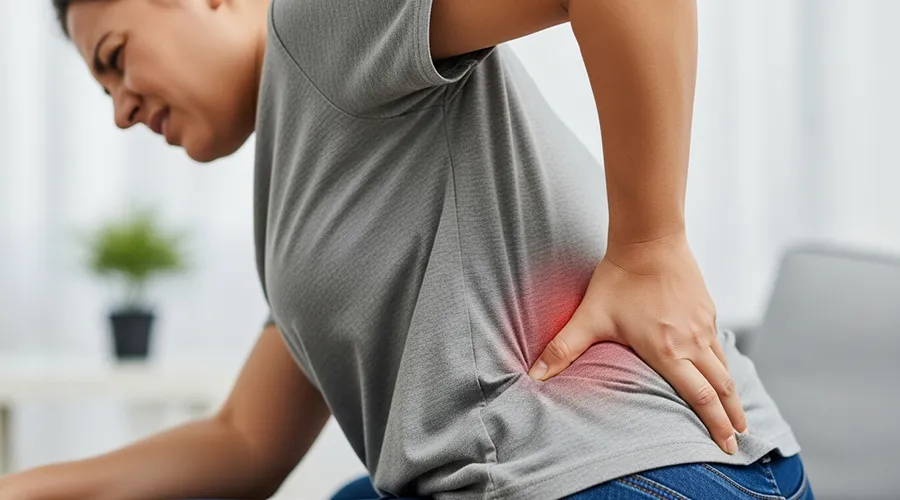
Feeling pain or discomfort in your lower right back can be alarming. The first question that likely crosses your mind is: “Is this just a simple muscle pull, or a sign of something more serious like a kidney problem or appendicitis?”
This concern is completely understandable. The good news is that back pain, in general, is extremely common—it’s estimated that about 80% of adults will experience it at some point in their lives. In most cases, the cause isn’t serious and will improve with simple home care.
The purpose of this comprehensive, “people-first” guide is not to frighten you, but to provide clear and credible information to help you understand the potential causes. We will help you better “triage” (prioritize) your pain.
Pain in this specific area usually falls into two main families:
- Mechanical Pain: This is the most common type of pain and relates directly to the structures of your back: muscles, ligaments, spinal bones, and nerves.
- Referred Pain: This is pain that you feel in your back, but its real origin is a problem in one of your internal organs (like the kidneys, appendix, or pelvic organs). Due to shared nerve pathways, it “refers” pain to your back.
In this article, we will explore the common causes of both types of pain. Most importantly, we will help you distinguish between pain you can safely manage at home and the “red flag symptoms” that require immediate medical attention.
The Most Common Causes: Mechanical Problems (Related to Muscles, Nerves, and Joints)
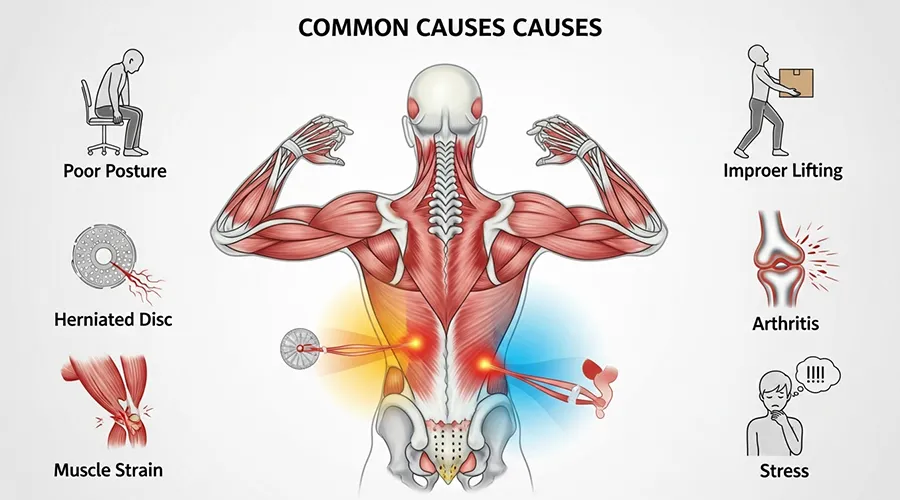
These are the most frequent reasons for lower back pain. A good rule of thumb is that mechanical pain usually changes with movement; it gets worse with a specific motion and better with rest or a change in position.
Muscle Strain or Ligament Sprain (The “Ouch!” Pain)
This is, without a doubt, the most common cause of acute (sudden) lower back pain.
- What do these terms mean?
- Strain: Occurs when a muscle or tendon (tissue connecting muscle to bone) is overstretched or torn.
- Sprain: Occurs when a ligament (tissue holding bones together) is stretched or torn.
To you, these two conditions will feel essentially the same. This usually happens from improperly lifting a heavy object, a sudden twist (like playing golf or picking up a child), poor posture over time, or overusing the muscles.
- Why does it hurt so much? (The Pain Mechanism) When a muscle is strained, like a rubber band stretched too far, microscopic tears form in its fibers. Your body immediately initiates an inflammatory response to repair the area. This response involves sending blood and fluids to the site of injury, causing the tissues to “swell.” It is this swelling and inflammation that presses on local nerve endings, causing the dull ache, stiffness, and often painful muscle “spasms” that you feel.
- Key Symptoms of a Muscle Strain:
- The pain is usually localized, meaning it’s felt right at the spot that was injured.
- The pain is described as dull, achy, or sore.
- The injured area may be tender to the touch.
- Muscle spasms or cramping are common.
- Stiffness and difficulty standing up straight or moving.
- Important Note: This type of pain does not typically shoot down the leg.
Sciatica (The Shooting Nerve Pain)
Many people call any type of back pain “sciatica,” but this term is often used incorrectly. Sciatica is not a disease; it is a symptom.
Sciatica is the name for pain caused by the compression or irritation of the “sciatic nerve”—the longest nerve in your body, which runs from your lower back down to the end of your leg. The most common cause of this compression is a bulging or herniated intervertebral disc.
- Key Symptoms of Sciatica:
- Pain is usually sharp, burning, or like an electric shock.
- Often accompanied by tingling (pins and needles), numbness, or weakness in the leg.
- The pain gets worse with movement, sneezing, or coughing.
- Is My Pain Sciatica? (Correcting a Common Misconception) This is the most important distinction: Sciatic pain is a traveling pain. It starts in the back or buttock and shoots down the back of one leg, often past the knee and sometimes to the toes.A simple rule: If your pain stays only in your back and doesn’t shoot down your leg, it is likely not sciatica. In true sciatica, the leg pain is usually much worse than the back pain.
Disc Problems and Spinal Structure
Sometimes, the problem is with the spinal structures themselves. We’ll use two simple analogies to understand this
- 1. Herniated Disc (The Jelly Donut Analogy) Between each of your vertebrae, there is a “disc” that acts like a soft cushion. These discs have a soft, gel-like center (nucleus) and a tougher outer layer (annulus).A herniated disc occurs when this disc is compressed like a jelly donut, and the jelly (soft center) squeezes out through a tear in the outer layer. This “jelly” can press directly on an adjacent nerve root (like the sciatic nerve) and cause pain.
- Symptoms: The pain is usually sudden, sharp, and shooting. This condition is more common in young to middle-aged adults.
- 2. Spinal Stenosis and Arthritis (The Narrowing Tunnel Analogy) Your nerves pass through a “tunnel” in the center of your spine called the “spinal canal.” With age, the spinal joints can experience “wear and tear,” or osteoarthritis.This arthritis causes the body to create extra bone (called bone spurs) and ligaments to thicken. This extra growth slowly thickens the “walls of the tunnel,” making the space for the nerves tighter. This is called “Spinal Stenosis.”
- Symptoms: The pain is usually gradual, dull, and chronic. It’s more common in older adults (usually over 50).
- Key Symptom: The pain gets worse with standing or walking for long periods but gets better with sitting or bending forward (like leaning on a shopping cart).
Sacroiliac (SI) Joint Dysfunction
This is a “great mimic” of back pain that is often overlooked.
The sacroiliac (SI) joint is the joint that connects your spine to your pelvis. Pain in this area can be caused by too much movement (instability) or too little movement (stiffness) in this joint.
- Key Symptoms:
- Pain is felt in the lower back, buttock, and sometimes the groin.
- Pain gets worse with prolonged sitting or standing, climbing stairs, or rising from a seated position.
- The “Sciatica Mimic”: Pain from the SI joint can feel very similar to sciatica or a herniated disc. But there’s a key difference: Pain originating from the SI joint, while it might radiate down the leg, “usually stays above the knee.” True sciatica, however, often goes below the knee. If you have sciatica-like pain that is mostly focused in your buttock and doesn’t go past your knee, your SI joint might be the problem.
Hidden Causes: When the Problem is an Internal Organ (Referred Pain)

This is a very important section. Sometimes, your back pain has nothing to do with your muscles or spine. Your internal organs (like your kidneys and appendix) share nerve pathways with your back muscles. When one of these organs has a problem, your brain misinterprets the pain signal and thinks your back is injured.
The key rule here is: Pain from internal organs usually does not change with body movement (bending or twisting). This pain is often constant and, most importantly, is almost always accompanied by other symptoms.
Kidney Problems (Stones or Infection) on the Right Side
The kidneys are located in an area where their pain is easily confused with back pain.
- Location of Kidney Pain: The kidneys are on either side of your spine, but below your ribs. Kidney pain is usually felt higher than “lower back” muscle pain and often feels deeper. (Your right kidney sits slightly lower than your left ).
- Scenario 1: Kidney Stones
- Quality of Pain: Very severe, sharp, and cramping (spasmodic).
- Pattern of Pain: The pain comes and goes in waves.
- Pain Migration: This is a key sign. The pain usually starts in the flank (in the back, under the ribs) and slowly wraps around the body toward the abdomen and groin.
- Associated Symptoms: Nausea and vomiting (due to the intensity of the pain) and pink, red, or brown (bloody) or cloudy urine.
- Scenario 2: Kidney Infection (Pyelonephritis)
- Quality of Pain: The pain is usually a dull, constant ache felt in the flank or back.
- Critical Associated Symptoms: This is the most important part. A kidney infection is a systemic infection, so it will cause fever and chills.
- Urinary Symptoms: Since a kidney infection usually starts from a bladder infection, you will also have urinary symptoms: burning or pain during urination, frequent urination, and cloudy or foul-smelling urine.
- The Golden Rule for Kidney Diagnosis: If you have back pain PLUS fever and chills, or your urine is strange (painful, bloody, smelly), the problem is not your muscle. This is a medical condition that requires an immediate visit to the doctor.
Appendicitis (A Medical Emergency)
Appendicitis (inflammation of the appendix) is a medical emergency that must be surgically treated quickly to prevent the appendix from bursting and causing a life-threatening infection in the abdomen.
- Classic Pain Path: “Classic” appendicitis pain usually starts near the belly button (around the abdomen). Then, over a few hours, this pain migrates to the lower right abdomen (not the back) and becomes constant, sharp, and very painful there.
- Associated Symptoms: Nausea, vomiting, complete loss of appetite, and fever.
- The Hidden Danger: Why Can Appendicitis Cause Back Pain? This is a dangerous diagnostic trap. The classic pain path described above is not true for everyone. People’s anatomy differs.In some people, the appendix is in an “atypical” or unusual position. Instead of being in the front of the abdomen, it may be located toward the back, behind the large intestine (this is called “retrocecal”).In these individuals, the inflamed appendix presses on and irritates the muscles and nerves of the back (like the psoas muscle) instead of the abdominal wall. One Persian source puts this well: “In some people, the appendix is located in the back near the right kidney instead of the front of the abdomen, which is why these people experience pain just like other types of back pain.”
Warning: Because of this risk, never ignore new, severe, and constant pain in the lower right area (whether abdomen or back) that is accompanied by fever, nausea, or loss of appetite. This is a medical emergency until proven otherwise.
Specific Causes in Women and Men
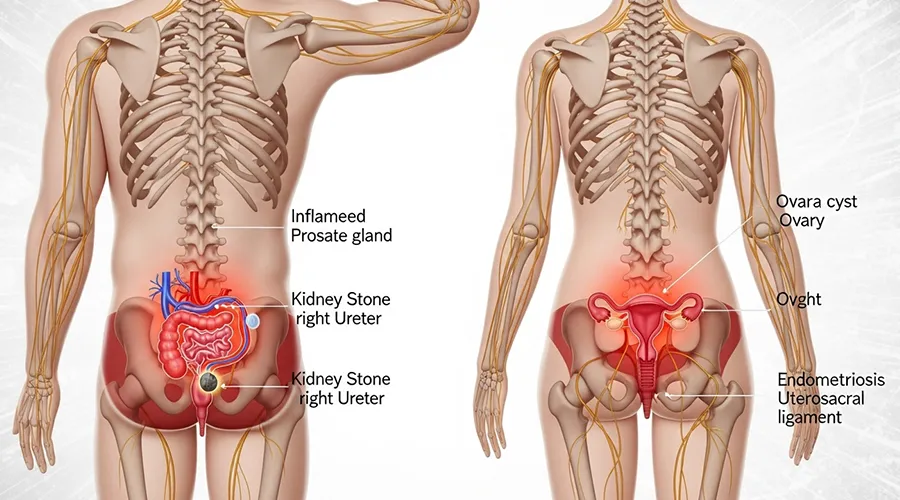
Some conditions unique to female or male anatomy can also cause pain that is felt in the lower right back.
Common Causes in Women
The reproductive organs are located in the pelvis, but inflammation and problems in these organs can easily cause referred pain to the back.
- 1. Endometriosis Endometriosis is a condition where tissue similar to the lining of the uterus (endometrium) grows outside the uterus, in places like the ovaries, fallopian tubes, and pelvic tissues.Why does it cause pain? This isn’t just “bad period pain.” This out-of-place tissue becomes chronically inflamed during the menstrual cycle and can cause scar tissue, called “adhesions,” to form. These adhesions act like glue and can “stick” your pelvic organs to each other or to the structures of your back. It is this physical pulling from the scar tissue that causes chronic pain.If these lesions or adhesions are on the right side of the pelvis (like on the right ovary or the ligaments supporting the uterus on the right side), they will cause pain in the lower right abdomen and back.
- Symptoms: The pain is often cyclical and gets worse with periods, ovulation, or sexual intercourse.
- 2. Other Causes
- Menstrual Pain (Dysmenorrhea): Uterine contractions can cause pain in the lower abdomen and back.
- Ovarian Cyst: A large or ruptured cyst on the right ovary can cause severe, sudden pain in the right pelvis and back.
- Uterine Fibroids: Noncancerous growths in the uterus that can press on the back, depending on their location.
Rare but Urgent Causes in Men
- Testicular Torsion This is rare, but it must be mentioned because time is critically important. Testicular torsion is a severe medical emergency. It occurs when the testicle rotates around the spermatic cord (the cord that supplies blood to the testicle), cutting off its blood flow.
- Symptoms: Sudden, extremely severe pain in the scrotum, accompanied by swelling, nausea, and vomiting.
- The Back Connection: The key here is referred pain. The severe pain from the testicle often radiates upward into the groin and lower abdomen. A person experiencing this might mistakenly describe their pain as “lower back” or “appendix” pain.
- Emergency Warning: There is only a very short time window, about 4 to 8 hours (some sources say 6 hours), to save the testicle from permanent damage (tissue death). If you are a man experiencing sudden, severe pain in the genital, groin, or lower abdominal area, this is an emergency and you must go to the hospital immediately.
Safe Home Treatments (Only for Muscle Pain)
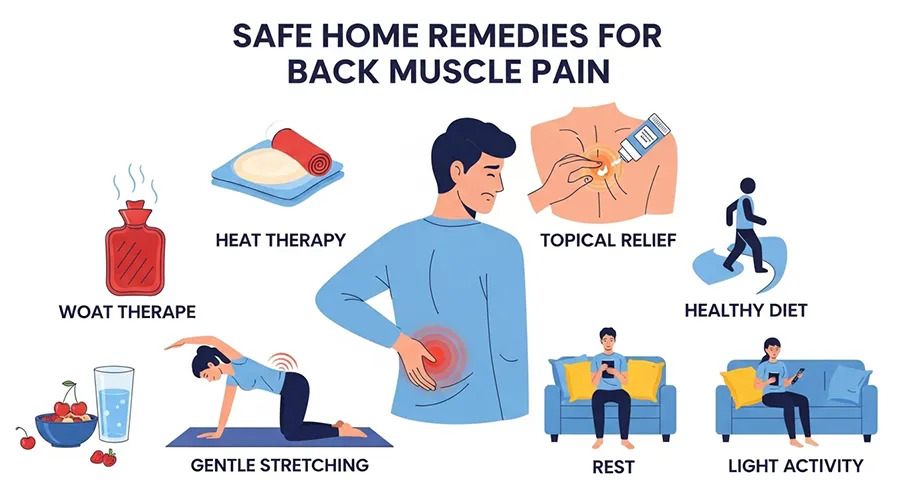
Very Important Warning: These treatments are only suitable for pain that you are confident is mechanical (muscular) and you do not have any of the red flag symptoms (explained in Section 6), such as fever, numbness, or severe abdominal pain.
Stay Active (The Myth of Bed Rest)
A common misconception is that you must stay in bed if you have back pain. Modern research says the exact opposite.
- Bed rest is not recommended.
- It is advised to only avoid your normal, strenuous activities “for the first few days” after the injury.
- You should “stay as active as possible.” Light aerobic activities like short walks, swimming, or a stationary bike (with no resistance) can increase blood flow to the injured area and help the healing process.
- The simple rule: Gentle movement is better than bed rest.
The Simple Rule of Ice vs. Heat
People are often confused about whether to use ice or heat. There is a very simple rule for this:
- 1. Cold (Ice): For Acute Injury (First 48-72 Hours)
- In the first two days after the injury, when the pain is new and sharp, use an ice pack.
- Why? Cold constricts blood vessels. This helps reduce inflammation, decrease swelling, and locally numb the pain.
- 2. Heat (Heating Pad): For Stiffness and Chronic Pain (After 72 Hours)
- After the first two or three days have passed, or for chronic pain and feelings of “tightness” and stiffness, use heat.
- Why? Heat dilates blood vessels. This increases blood flow (and thus oxygen and nutrients) to the area, helping to relax stiff muscles and relieve pain.
- The Simple Rule: Ice for INJURY, Heat for STIFFNESS.
Gentle and Safe Stretches
After the initial acute pain has subsided, very gentle stretches can help restore range of motion and reduce stiffness.
Safety Warning: These movements should not cause pain. If you feel sharp pain while doing a movement, stop immediately.
- Knee-to-Chest Stretch:
- Lie on your back with your knees bent and feet flat on the floor.
- Gently grasp one knee with both hands and pull it toward your chest until you feel a gentle stretch.
- Hold for 5 to 10 seconds, then slowly release the leg. Repeat for the other leg.
- Lower Back Rotational Stretch:
- Lie on your back with knees bent and feet flat on the floor. Open your arms to the sides (like a T).
- Keeping your shoulders flat on the floor, slowly rotate both bent knees together to the right side.
- Hold for 5 to 10 seconds. Return to the center, and then slowly rotate to the left side.
- Cat-Cow Stretch:
- Get on all fours (hands under shoulders, knees under hips).
- Cat pose: Exhale and slowly round your back (like a scared cat), pulling your belly button in and letting your head drop.
- Cow pose: Inhale and slowly drop your belly toward the floor, arching your back and gently lifting your head.
Prevention: The Power of Good Posture
Much back pain comes from the daily stress we put on our spine due to poor posture, especially when sitting.
- When Sitting: Avoid crossing your legs. Both feet should be flat on the floor. Rest your back fully against the back of the chair and keep your shoulders relaxed.
- When Standing: Stand tall, head up, shoulders back, abdomen pulled in slightly, and distribute your weight evenly on both feet.
- When Sleeping: Your sleeping position matters. If you sleep on your side, place a pillow between your knees. If you sleep on your back, place a pillow under your knees to take pressure off your back.
Red Flag Symptoms: When to Go to the Emergency Room Immediately
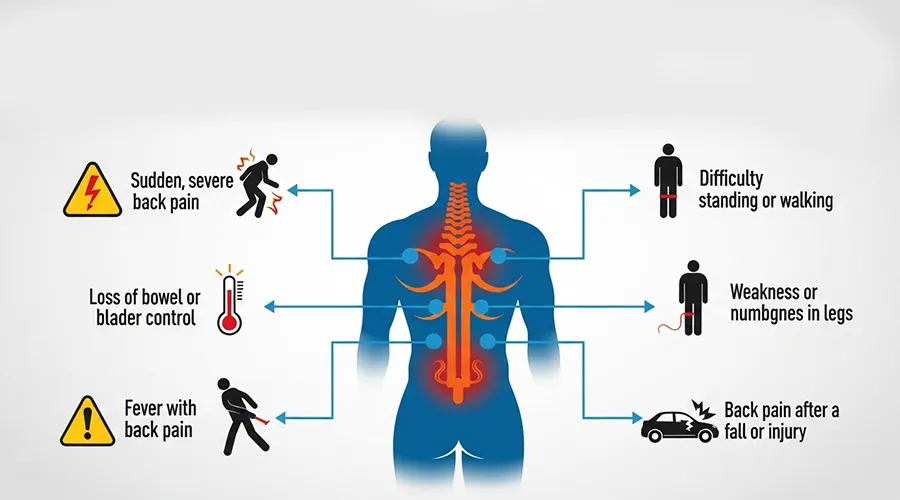
This is the most important section of this article for your safety. Our tone here is serious and firm.
If your lower back pain is accompanied by any of the following symptoms, ignore home remedies, do not wait, and go to the nearest emergency room immediately or call 115 (or your local emergency number).
- Loss of Bladder or Bowel Control: Sudden loss of urine control (urinary incontinence) or bowel control (fecal incontinence), or, conversely, a sudden inability to urinate (urinary retention).
- Saddle Anesthesia: Numbness, tingling, or sudden loss of sensation in the groin, buttocks, genital area, and inner thighs. (Essentially, the area of your body that would touch a saddle if you were riding a horse).
- Progressive Leg Weakness: Sudden and increasing weakness in one or both legs. This isn’t just a feeling of fatigue, but a physical inability to stand on your toes, or a feeling of your leg “dragging” when you walk, making it difficult to stand or walk.
- Pain with Fever and Chills: Back pain accompanied by a high fever, chills, or night sweats. This can be a sign of a serious infection, like a kidney infection or an infection in the spine (osteomyelitis).
- Severe Abdominal Pain: Sudden, severe, and tearing pain that starts in the back and radiates to the abdomen. (This could be a sign of a vascular emergency like an Abdominal Aortic Aneurysm (AAA)).
- After a Serious Injury: Pain that starts immediately after a severe trauma, a fall from a height, or a car accident (this could signal a fracture).
- With Unexplained Weight Loss: Persistent back pain accompanied by significant, unintentional weight loss that you cannot explain.
Special Explanation: Cauda Equina Syndrome
Symptoms 1, 2, and 3 on the list above (incontinence, saddle anesthesia, and leg weakness) are the classic signs of a very serious but rare emergency condition called “Cauda Equina Syndrome.”
Why is this an immediate emergency? At the end of your spine, the spinal cord transitions into a bundle of nerve roots that looks like a horse’s tail (Cauda Equina is Latin for “horse’s tail”). These nerves control all the functions of your legs, bladder, and bowels.
This syndrome occurs when something (usually a very large herniated disc) severely compresses or crushes this bundle of nerves. This is a surgical emergency. If this pressure is not relieved within a few hours, the nerves can die, leading to permanent damage, including paralysis of the legs and permanent loss of bladder and bowel control. That is why these symptoms require an immediate trip to the emergency room.
Conclusion and Next Steps
Listen to your body. Remember that the vast majority of lower back pain (about 80%) is mechanical and muscular, and will improve with time, gentle movement, and the home care we’ve described.
Your body is your primary guide.
- If your pain is localized, changes with movement, and you have no other worrying symptoms, it is likely a muscle strain or mechanical issue.
- But if your pain is constant, doesn’t change with movement, or is accompanied by systemic symptoms (like fever, chills, nausea) or urinary symptoms, the problem is likely an internal organ.
- And if you experience sudden numbness, severe leg weakness, or loss of bladder or bowel control, this is your body’s signal to call for immediate, emergency help