
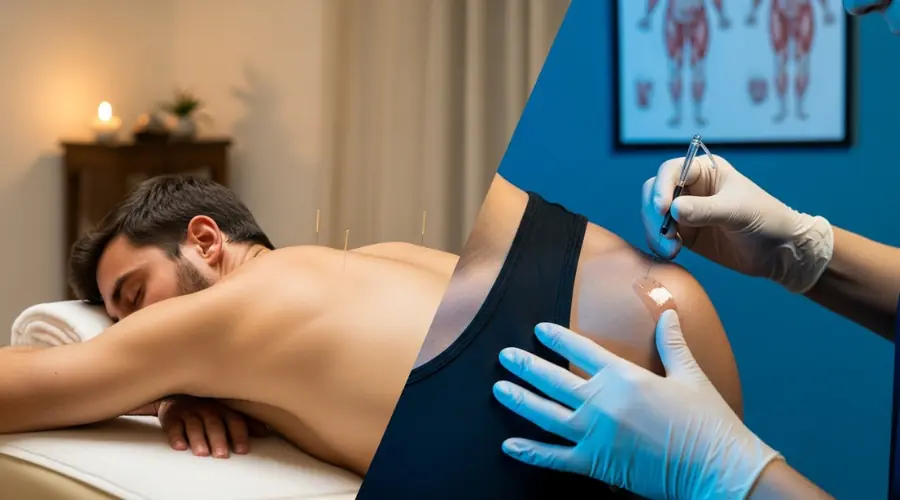
If you are suffering from pain, you may have heard about two treatments that sound confusingly similar: dry needling and acupuncture. Both involve the use of thin, solid needles inserted into the skin to provide relief. From the outside, they can look identical. However, the only true similarity between them is the tool they use. This is where the comparison ends.
The difference is not in the needle, but in the philosophy, the purpose, and the practitioner. One is an ancient, holistic medical system designed to balance the entire body’s energy. The other is a modern, Western medical technique designed to release specific, tight muscle knots.
Because this is a health topic involving an invasive procedure, it is crucial to understand these differences. This guide will provide a clear, simple, and trustworthy comparison. It will explain what each therapy is, how it works, what the research says, and the vast differences in practitioner training and safety. This information is designed to help you have an informed conversation with your doctor or physical therapist.
What is Acupuncture? An Ancient System for Holistic Health
The Philosophy: 3,000 Years of Traditional Chinese Medicine
Acupuncture is not a single, modern technique but a key component of a complete medical system called Traditional Chinese Medicine (TCM), which has been practiced for millennia.
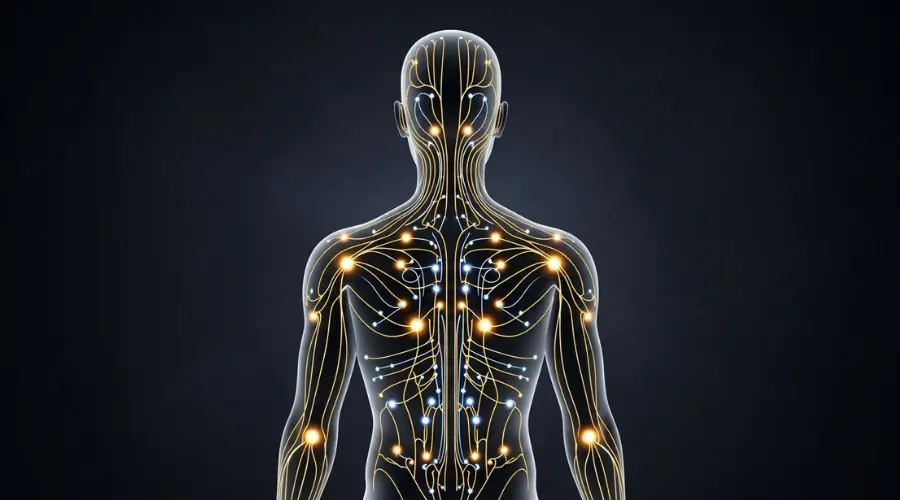
The core philosophy of TCM is built on the concept of Qi (pronounced “chee”). Qi is understood as the body’s “vital energy” or “life force”. According to TCM, this energy flows through the body in specific pathways, or channels, known as meridians.
In this system, a healthy, pain-free person has Qi that flows smoothly and in balance. Pain, illness, and other symptoms—whether it’s back pain, anxiety, or nausea—are seen as a sign that the flow of Qi is blocked, “stuck,” or unbalanced.
The Goal & How it Works: Restoring Systemic Balance
The goal of an acupuncturist is not just to treat one symptom, but to restore the body’s systemic balance and promote overall well-being.
To do this, the practitioner inserts thin, sterile needles into specific “acupoints” located along the meridians.This stimulation is intended to unblock the flow of Qi and encourage the body’s own natural healing response.
This is why an acupuncturist treating a headache might place needles in your hand or foot. They are not treating the location of the pain; they are treating the meridian (the energy pathway) that, according to TCM, is out of balance and causing the symptom.
What Does the Evidence Say? Conditions Acupuncture Treats
While its roots are ancient, acupuncture is supported by a large and growing body of modern scientific research.
- Chronic Pain: A major 2018 individual patient data meta-analysis, a very high-quality form of research, confirmed that acupuncture is effective for treating chronic pain, including neck and back pain, osteoarthritis, and chronic headaches. The study also concluded that acupuncture is more than just a placebo, showing significant differences between true acupuncture and sham (fake) acupuncture.
- Migraine & Headaches: Multiple systematic reviews and meta-analyses published in 2024 have shown that acupuncture can be superior to medication for the prevention of migraines. These studies found that acupuncture therapy reduced the pain intensity, frequency, and duration of migraine attacks better than drug-based therapies.
- Broad Applications: The World Health Organization (WHO) recognizes acupuncture’s potential effectiveness for hundreds of conditions. In clinical practice, it is commonly used to treat a wide range of issues beyond pain, including nausea and vomiting (often from chemotherapy), allergies, anxiety, digestive issues, and sleep disorders.
Who Performs It?
Acupuncture is performed by Licensed Acupuncturists (L.Ac.). This is a highly regulated profession with extensive training requirements, which will be discussed in detail in Section
What is Dry Needling? A Modern Technique for Muscle Pain
The Philosophy: Modern, Western, and Anatomical
Dry needling is a much newer treatment, developed within the last few decades. It is not part of Traditional Chinese Medicine and has no connection to Qi or meridians.
Instead, dry needling is based on modern Western medicine, anatomy, and physiology.
The “dry” in the name is a simple distinction: the needle is “dry” because it is solid and does not inject any liquid, as a “wet” needle would (for example, an injection of cortisone or lidocaine).
The Goal & How it Works: Releasing “Trigger Points”
The goal of dry needling is specific, mechanical, and targeted: to treat myofascial trigger points.
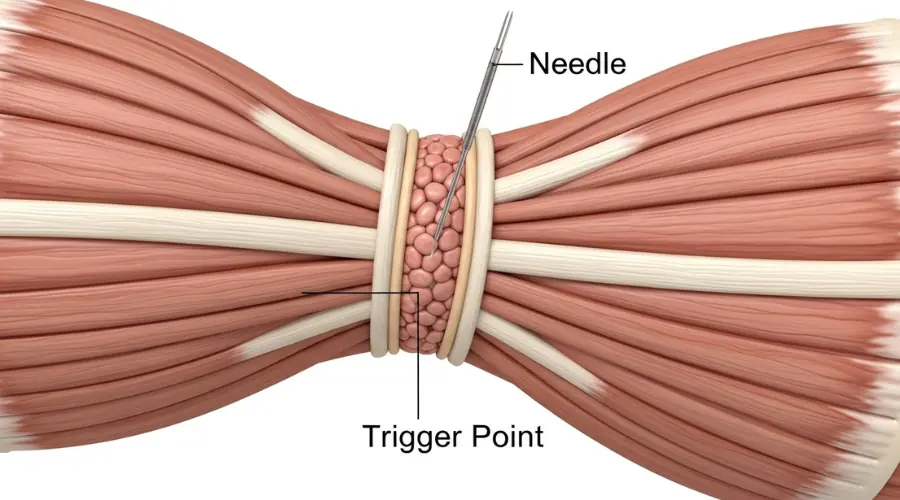
In simple terms, a trigger point is a “muscle knot.” It is a small, tight, irritable, and dysfunctional band of muscle tissue. These knots can be a source of local pain, but they can also restrict movement or cause “referred pain”—pain that is felt in a different part of the body. A common example is a trigger point in the shoulder (trapezius) muscle causing a tension headache.
A practitioner, typically a physical therapist, will use their hands to feel for these tight bands or knots. They then insert a thin needle directly into the trigger point.
The goal is often to elicit a “local twitch response”—a small, involuntary muscle spasm or cramp. This twitch is believed to act as a “reset” button for the muscle. The response is thought to cause the tight muscle fibers to release, reduce local inflammation, increase blood flow, and ultimately decrease pain.
What Does the Evidence Say? Conditions Dry Needling Treats
Because dry needling is a newer technique, the body of research is smaller and more focused, but it is “mounting”.
- Musculoskeletal Pain: The treatment is used almost exclusively for musculoskeletal and neuromuscular pain.
- Low Back & Neck Pain: A 2023 systematic review concluded that dry needling is an effective procedure for reducing pain and disability in patients with myofascial low back pain. Similarly, a 2024 systematic review on chronic neck pain found that dry needling improved pain and function in the short-to-medium term.
- Focused Applications: It is widely used by physical therapists for sports injuries and specific conditions like rotator cuff pain, tennis elbow, iliotibial (IT) band syndrome, plantar fasciitis, and temporomandibular (TMJ) jaw pain.
It is important to note that dry needling is rarely a standalone treatment. It is almost always used as one part of a broader physical therapy or rehabilitation plan. This plan typically includes exercise, stretching, and manual therapy to address the underlying movement issues or weaknesses that caused the trigger points to form in the first place.
Who Performs It?
Dry needling is typically performed by Physical Therapists (PTs), chiropractors, or medical doctors who have taken specific post-graduate certification courses in the technique.
A Simple Analogy: The Garden and the Hose
To make the difference perfectly clear, let’s use an analogy. Think of your body as a large, complex garden.
Acupuncture is the Garden’s Ecosystem Manager. An acupuncturist is like a master gardener who tends to the entire ecosystem. They aren’t just looking at one dying leaf. They are checking the main water valves, the soil quality, and the sunlight. By adjusting the main irrigation valves (the meridians), they aim to restore the proper flow of water and nutrients (Qi) to the entire garden (the body), improving its overall health and resilience.
Dry Needling is the Kink-in-the-Hose Specialist. A physical therapist performing dry needling is like a specialist you call to fix a single, kinked hose (the trigger point) that’s stopping water from getting to one specific plant. They go directly to that kink and use a sharp tool (the needle) to “un-kink” it, immediately restoring flow and function to that specific area (the muscle).
Both have a role, but one treats the whole system (acupuncture) while the other targets a specific mechanical problem (dry needling).
Acupuncture vs. Dry Needling: Key Differences
Acupuncture:
Medical Philosophy: Traditional Chinese Medicine (TCM)
Core Concept: Balancing Qi (Energy) Flow via Meridians
Treatment Goal: Holistic Health & Systemic Balance
Body Targets: Specific Acupoints on Meridians (can be far from the area of pain)
Evidence Base: Vast & Established (e.g., chronic pain, migraine)
Typical Practitioner: Licensed Acupuncturist (L.Ac.)
Dry Needling:
Medical Philosophy: Modern Western Medicine
Core Concept: Releasing Muscular Trigger Points (Knots)
Treatment Goal: Targeted Musculoskeletal Pain Relief
Body Targets: Myofascial Trigger Points (directly in the “knot”)
Evidence Base: New & Emerging (e.g., myofascial pain)
Typical Practitioner: Physical Therapist (PT), Chiropractor
Safety, Training & The Professional Debate: The Most Important Section
Because both treatments are invasive (they break the skin), the single most important factor for your health and safety is the training and expertise of the person performing the procedure.
This is where the two therapies are the most different, and this difference is the source of a significant, ongoing debate among medical professionals.

Who Is Holding the Needle? A Look at Training
- Licensed Acupuncturist (L.Ac.):
- Degree: To become a licensed acupuncturist, a person must complete a 3-4 year Master’s or Doctoral degree from an accredited institution.
- Training Hours: This program involves 2,000 to 3,000+ hours of education. This includes hundreds of hours of supervised, hands-on clinical practice.
- Licensing: Graduates must then pass national board examinations from the NCCAOM (National Certification Commission for Acupuncture and Oriental Medicine) and be licensed by the state. Their entire graduate education is focused on human anatomy, physiology, and the safe application of needle-based therapy.
- Physical Therapist (PT) performing Dry Needling:
- Degree: Physical therapists are highly trained medical professionals who earn a doctoral degree (DPT) in movement science and human anatomy.
- Training Hours: However, dry needling is not part of the core DPT curriculum. It is a post-graduate certification. There is no single national standard for this certification. Training requirements are set by individual states and can be minimal, often consisting of “abbreviated continuing education workshops”. This typically involves 50 to 80 hours of coursework (for example, 54 hours in Delaware, 50 in Indiana, and 40-80 in Maryland).
The Professional Debate (And Why It Matters to You)
This vast difference in training (2,000+ hours vs. 50+ hours) fuels a genuine dispute over patient safety.
- The Acupuncturist & Medical Position: National acupuncture bodies (like NCCAOM) and some medical groups (like the American Academy of Medical Acupuncture) state that dry needling is not a new procedure. They argue it is a “rebranded” form of acupuncture—specifically, the use of “Ashi” points (tender-to-the-touch points, which are functionally identical to trigger points). They classify it as an “invasive procedure” and have stated that 50 hours of “substandard” training is insufficient and “has the potential to cause great harm”.
- The Physical Therapist Position: The American Physical Therapy Association (APTA) states that dry needling is different from acupuncture because its rationale is based on Western anatomical and neurophysiological principles, not on Qi or meridians. They maintain that it is safely within a PT’s scope of practice, given their extensive doctoral-level knowledge of anatomy, and that the specialized certification courses are sufficient to perform it safely.
As a patient, you cannot solve this professional debate. But you can and should ask your practitioner about their specific training. Ask them: “How many hours of training in this specific needle technique have you had?” and “How long have you been performing it?”
Risks and Side Effects
The difference in training is at the center of the debate over risks.
- Acupuncture: When performed by a Licensed Acupuncturist, the risk is extremely low. In the past, there were risks of infection (like hepatitis) from reusable needles. Today, practitioners are required to use sterile, single-use, disposable needles, which has eliminated this risk. The most common side effects are very minor, such as slight soreness or bruising at the needle site.
- Dry Needling:
- Minor side effects are common: This is a key difference. One large study of over 20,000 dry needling treatments found that minor adverse events (AEs) occurred in 36.7% of sessions—more than one in three. Another study found over 50% of patients reported post-treatment soreness.
- The most common minor AEs are: bleeding (16%), bruising (7.7%), and pain during the treatment (5.9%).
- Major side effects are rare: The same large study found the rate of major complications was very low, at less than 0.1% (or 1 in 1,024 treatments).
- The specific, serious risk: Pneumothorax (Collapsed Lung). This is the most serious risk associated with needling and the one at the heart of the training debate. It can happen if a needle is inserted incorrectly in the neck, shoulder, or ribcage area and punctures the lung. This is a medical emergency. While it is considered very rare, some recent medical case reports have suggested it may be “not extremely rare” and could be under-reported as the technique’s popularity grows.

How to Choose: Which Therapy Is Right for Me?
This article cannot tell you which treatment to get, but it can help you build a decision framework to discuss with your doctor.
A. Consider Acupuncture if:
- Your condition is systemic or widespread, such as migraines , chronic headaches , widespread inflammatory pain, anxiety, or allergies.
- You are seeking a holistic approach that aims to improve your overall well-being (e.g., sleep, mood, energy) in addition to your main complaint.
- You prefer a time-tested treatment with thousands of years of history and a vast, established body of modern scientific evidence.
- You are more comfortable with a practitioner who has thousands of hours of graduate-level training and state licensure specifically in needle-based therapy.
B. Consider Dry Needling if:
- Your problem is specific, localized, and muscular, such as a “knot” in your shoulder, a specific sports injury, TMJ pain, or localized low back pain.
- You have been diagnosed with myofascial trigger points by a doctor or physical therapist.
- You want a focused, modern, anatomical approach.
- You are already seeing a physical therapist, and they suggest it as part of a comprehensive rehabilitation plan that also includes exercise and manual therapy.
C. The Most Important Step: Get a Diagnosis First
Do not self-diagnose. The most crucial step is to see a qualified medical professional (such as your primary care physician or a specialist) to get an accurate diagnosis for your pain. Once you know why you are in pain, you can have an intelligent and informed conversation with your healthcare team about all your treatment options, including whether acupuncture or dry needling is a safe and appropriate choice for you.
Conclusion: A Shared Goal, Different Paths
Dry needling and acupuncture are not the same. They are two distinct therapies that use a similar tool to achieve very different goals, guided by completely different medical philosophies.
Acupuncture is a holistic, energy-based system designed to treat the entire body, performed by Licensed Acupuncturists with thousands of hours of training. Dry needling is a modern, targeted, muscle-based technique used to release knots, most often performed by Physical Therapists as one part of a larger rehabilitation plan.
Find out if Dry Needling is the right solution for you at our clinic.