
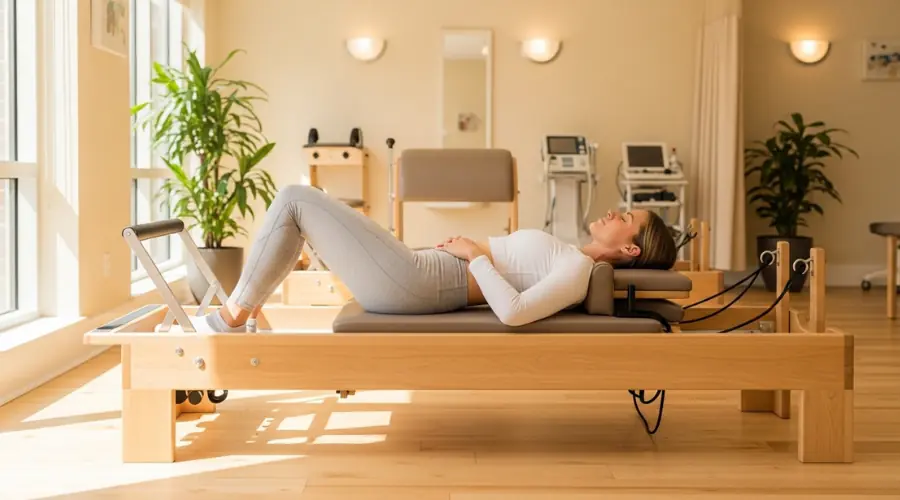
If you are reading this, you are likely one of the estimated 619 million people globally who suffer from low back pain. Whether it’s a dull ache from sitting at a desk all day, a sharp twinge from an old injury, or chronic discomfort that makes getting out of bed a challenge, back pain is more than just a physical sensation—it’s an exhausting interruption to your life.
For years, the standard advice was “bed rest.” However, modern physiotherapy and clinical research have shifted the paradigm. We now know that movement is medicine, provided it is the right kind of movement.
Enter reformer pilates for back pain.
Unlike high-impact gym workouts that can compress your spine, or generic stretching that might not address the root cause, Reformer Pilates is a system often used by rehabilitation specialists to rebuild the body from the inside out. It doesn’t just treat the symptom; it builds a “natural corset” of muscle to protect your spine for the long term.
In this guide, we will explore why the Reformer is a superior tool for back rehabilitation, the specific science behind it, and actionable exercises you can try under professional guidance to reclaim your comfort.
Why Reformer Pilates for Lower Back Pain is the Best Solution
Many of our clients ask, “Why can’t I just do Pilates on a mat at home?” While Mat Pilates is fantastic, the Reformer offers unique mechanical advantages specifically designed for rehabilitation, making it the gold standard for treating reformer pilates for lower back pain.
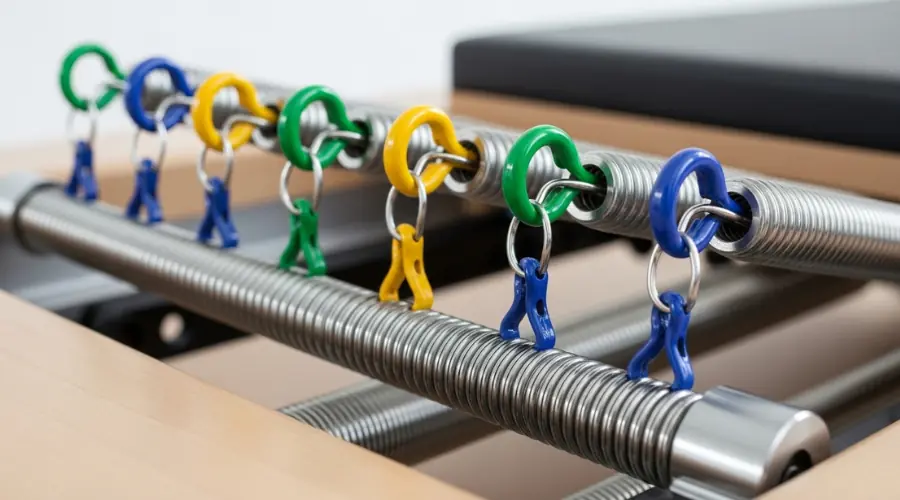
1. The Magic of Spring Resistance (vs. Gravity)
On a mat, you are at the mercy of gravity. If your core is weak, gravity will often force your lower back to take over the work, potentially causing more pain.
The Reformer is different. It uses a system of springs to provide variable resistance.
- Support: The springs can actually support the weight of your legs or torso, making movements feels “weightless.” This allows you to move your joints without compressing the spine.
- Assistance: As the clinical analysis suggests, the springs assist you during the most vulnerable parts of a movement, ensuring your muscles engage correctly without straining.
- Eccentric Control: The springs don’t just pull; you have to control them as they release. This “braking” action (eccentric contraction) is proven to strengthen connective tissue and remodel tendons, which is vital for healing.
2. The “Closed Kinetic Chain” Advantage
This sounds technical, but it’s a simple concept with huge benefits. In many Reformer exercises (like Footwork), your feet or hands are fixed against a solid bar while your body moves.
Clinical studies show that these “Closed Kinetic Chain” movements significantly reduce “shear forces” on the lumbar vertebrae. Simply put, reformer pilates lower back pain exercises are often safer for your discs than open-air exercises (like lifting your legs while lying on the floor) because the machine helps stabilize your joints.
3. Targeting the “Deep System”
Back pain often stems from a “power outage” in your deep core. In healthy backs, muscles like the Transversus Abdominis (your deep corset) and the Multifidus (small stabilizers along your spine) fire milliseconds before you move your arm or leg. In people with chronic back pain, this mechanism is often delayed or absent.
The unstable nature of the moving carriage forces your body to instinctively reactivate these deep muscles to keep you steady. It retrains your brain to protect your spine automatically.
The Science: How Reformer Pilates Improves Posture to Reduce Pain
Chronic back pain is rarely just about the back; it is often about how you hold yourself. If your pelvis is tilted too far forward or back, or if one hip is higher than the other, your lower back takes the hit.
Neutral Spine: The Holy Grail of Rehab
Reformer Pilates relies heavily on the concept of the “Neutral Spine.” This is the position where your spine creates its natural curves—a slight hollow in the lower back—which is mechanically the strongest and most shock-absorbing position for your body.
The Reformer provides immediate feedback. Because you are often lying on a firm, flat carriage with shoulder blocks and a footbar, you (and your instructor) can instantly see if you are crooked, twisted, or collapsed. The machine acts as a ruler, helping you align your hips, shoulders, and ribs.
Correcting Pelvic Alignment
Tight hip flexors (from sitting) can pull your pelvis forward, compressing the lower back. Weak glutes (from lack of activity) fail to support the pelvis. The Reformer addresses both simultaneously: it stretches tight hips while strengthening weak glutes, restoring the pelvic balance necessary to relieve chronic pain.
5 Best Reformer Pilates Exercises for Lower Back Pain Relief
Note: These exercises should always be performed under the supervision of a certified instructor or physiotherapist, especially if you are currently in pain. The goal is “Slow and Controlled.”
1. Pelvic Tilt (Warm-up)
Before any major movement, we must mobilize the spine.
- The Move: Lying on your back on the carriage with knees bent and feet on the footbar. Exhale to gently rock your pelvis back, flattening your lower back into the carriage. Inhale to return to neutral (slight space under the back).
- The Benefit: This acts as a massage for the lumbar spine and wakes up the deep abdominal muscles without any strain.
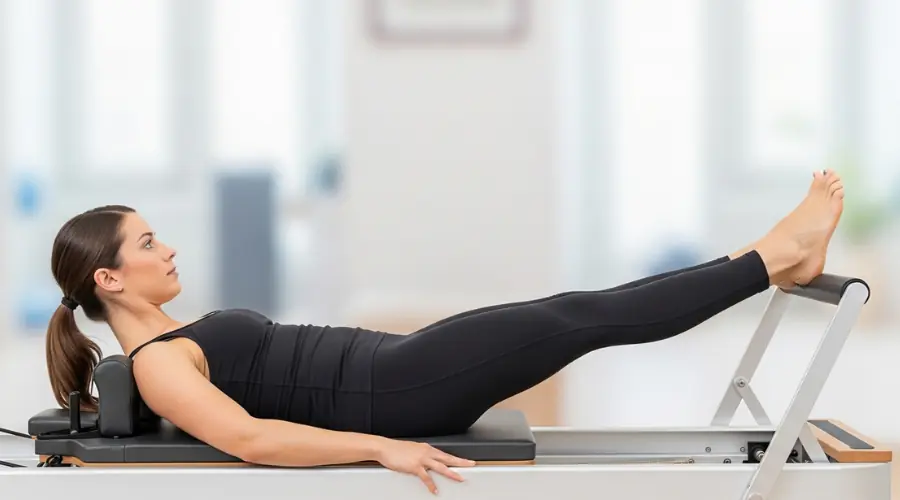
2. Reformer Footwork (Heels/Toes)
This is the foundational exercise of Pilates.
- The Move: Lying on your back, feet on the footbar. You push the carriage out by straightening your legs and slowly return.
- The Benefit: This strengthens the legs, glutes, and quadriceps. Stronger legs mean you lift with your legs, not your back, in daily life. Because you are lying down, there is zero vertical pressure on your spine.
- Why it works: It teaches “pelvic stability”—keeping your spine still while your legs move.
3. Knee Folds / Leg Changes
- The Move: Lying on your back with straps on your hands or just stabilizing your body. You lift one leg to a “tabletop” position (90 degrees) and lower it, then switch.
- The Benefit: This targets the Transversus Abdominis. The challenge is to keep the carriage (and your hips) completely still while lifting the weight of your leg. It’s a subtle but powerful way to fix the “wobbly” core that causes pain.
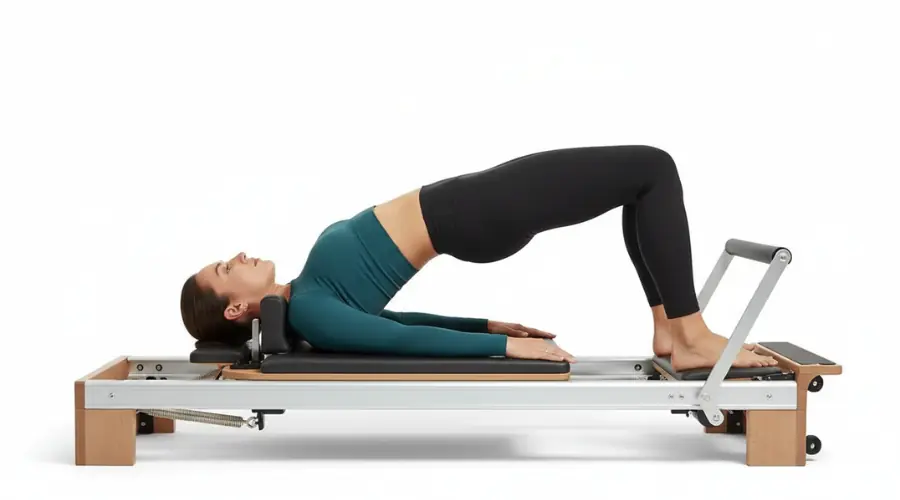
4. Bridging (Hip Rolls)
Weak glutes are a leading cause of back pain. If your glutes don’t work, your lower back muscles (Erectors) have to work overtime.
- The Move: Lying on your back, you peel your spine off the carriage one vertebra at a time until you are resting on your shoulder blades, then roll back down.
- The Benefit: This strengthens the glutes and hamstrings while mobilizing a stiff spine. The rolling motion helps lubricate the spinal joints.
- Safety Tip: Ensure the headrest is flat to protect your neck!
5. Seated Spine Twist
- The Move: Sitting on the carriage or a box, you gently rotate your upper body to one side, then the other.
- The Benefit: Stiffness in the upper back (Thoracic spine) forces the lower back to twist more than it should. By loosening the upper back, we take the pressure off the lumbar region.
Effective Pilates Reformer Exercises for Sciatica & Nerve Relief
Sciatica—pain radiating along the sciatic nerve, which runs down one or both legs from the lower back—requires a specific approach. The goal is to create space and reduce compression. Here are specific pilates reformer exercises for sciatica that we recommend.
Exercise A: Feet in Straps (Hamstring Stretch & Leg Circles)
This is often described by clients as the most relieving feeling for back pain.
- The Move: You lie on your back, and the long straps are placed around the arches of your feet. The springs support the full weight of your legs. You gently circle the legs or lower and lift them.
- Why it helps:
- Decompression: The straps lift the legs, allowing the thigh bone to settle deep into the hip socket. This creates space in the hip joint and relieves tension in the lower back.
- Safe Stretching: Tight hamstrings pull on the pelvis and worsen sciatica. This exercise stretches the hamstrings without forcing you to round your back (which can aggravate discs).
- Nerve Gliding: The gentle motion helps “floss” or glide the nerve, reducing adhesions and inflammation.
Exercise B: The Mermaid (Side Stretch)
- The Move: Sitting sideways on the reformer, one hand on the footbar. You push the bar away and stretch your arm overhead, creating a long curve with your body.
- Why it helps: This opens up the Quadratus Lumborum (QL), a deep muscle in the side of your lower back that is often chronically tight and spasmed in sciatica patients.
Exercise C: Figure 4 Stretch (on Reformer)
- The Move: Lying on your back, you cross one ankle over the opposite knee. You use the footbar or strap to gently pull the legs toward you.
- Why it helps: This specifically targets the Piriformis muscle. In many cases of sciatica, the sciatic nerve is compressed by a tight Piriformis muscle (Piriformis Syndrome). Releasing this muscle can provide immediate relief.
Safety Guidelines: How to Practice Reformer Pilates for Back Pain Safely
When dealing with back pain, the “No Pain, No Gain” mentality can be dangerous. At our clinic, we follow a strict safety protocol derived from YMYL (Your Money or Your Life) health standards.
1. The Traffic Light System
- Green Light: The movement feels good, or you feel muscles working (burning in the abs or glutes). Keep going.
- Amber Light: You feel mild discomfort or uncertainty. Slow down, reduce the spring tension, or reduce the range of motion.
- Red Light: You feel sharp, shooting, or radiating pain. Stop immediately. This is your body telling you that you are compressing a nerve or joint.
2. Consult Professionals First
Before starting, get clearance from your doctor. If you have a specific condition like Spondylolisthesis or Spinal Stenosis, certain movements (like extension) might need to be avoided. A qualified instructor will know how to modify the machine for you.
3. Modification is Key
The beauty of the Reformer is its adjustability.
- If your back hurts during leg lifts, we make the springs heavier to support you more.
- If you can’t sit up straight due to tight hamstrings, we sit you on a “box” to elevate your hips.
- We can limit how far the carriage moves to ensure you stay in a safe range.
FAQs: Common Questions About Reformer Pilates for Back Pain
Is Reformer Pilates good for lower back pain?
Yes. Comprehensive analysis shows that Pilates is effective for managing Chronic Low Back Pain (CLBP). It works by increasing the thickness of the stabilizing muscles (Transversus Abdominis) and correcting the postural habits that cause pain in the first place.
How often should I do Reformer Pilates for back pain?
Consistency is vital. Clinical guidelines suggest that 2 to 3 sessions per week is the optimal dosage. Doing it once a week is often not enough to retrain the neuromuscular system, while doing it every day initially might not allow atrophied muscles enough time to recover.
Can Pilates make back pain worse?
It can, if performed with poor form or without proper guidance. For example, aggressive twisting or deep forward bending can aggravate a herniated disc. This is why starting with a private session or a clinical pilates class is highly recommended over a large group fitness class.
I have a herniated disc. Can I still do Pilates?
Generally, yes, but with modifications. We typically focus on “Extension Bias” exercises (gentle backward bending) and avoid “Flexion” (rounding the spine) in the early stages to prevent pushing the disc further onto the nerve. Always inform your instructor of your diagnosis.
Conclusion: Start Your Journey to a Pain-Free Life with Reformer Pilates
Living with back pain is physically and emotionally draining, but it doesn’t have to be permanent. Reformer pilates for back pain offers a scientifically backed, gentle, and effective path to recovery.
By stabilizing your core, correcting your alignment, and strengthening the muscles that support your spine, you aren’t just fixing the pain for today—you are building a body that is resilient against pain in the future.
You don’t have to navigate this journey alone. Our clinic specializes in Clinical Reformer Pilates, where every session is tailored to your specific history and pain levels.
Ready to build your natural corset and reclaim your movement?