
The meteoric rise of padel in the United Arab Emirates, particularly within the urban fabric of Dubai, represents one of the most significant shifts in the regional sports landscape over the last decade. Statistics from recent market analyses indicate a staggering 3,000% increase in search interest for “padel” over the previous five years, with a 60.3% growth rate recorded in the last twelve months alone. This expansion is not merely a quantitative increase in participation but a qualitative transformation of the sport from a niche expat activity into a cornerstone of national fitness culture, bolstered by the involvement of the Dubai royal family and local celebrities. As of 2025, Dubai has solidified its position as the padel capital of the region, driving the majority of the nation’s interest and infrastructure development. This surge has necessitated a parallel evolution in the sports medicine sector, as the unique biomechanical demands of the sport have led to a distinct clinical profile of injuries among the estimated 25 million players globally.
The maturation of the padel market in Dubai is evidenced by the shift in consumer behavior from general curiosity to specific, goal-oriented engagement. While early search patterns were focused on basic inquiries such as “what is padel,” the current trend in 2024 and 2025 emphasizes location-specific discovery, equipment optimization, and advanced coaching. The development of a full padel ecosystem in areas like Al Quoz, Al Barsha, and Dubai Sports City, exemplified by facilities such as the ISD Padel center and the World Padel Academy, reflects a community that is increasingly professionalized. This professionalization is further highlighted by the 32% increase in e-commerce sales for padel equipment between 2022 and 2024, with lightweight carbon fiber rackets now accounting for 65% of new product launches.
Socio-Economic and Demographic Foundations of the Dubai Padel Surge
The demographic profile of padel in Dubai is notably skewed toward the 18–34 age group, which accounts for nearly 60% of global participants. However, the sport’s accessibility has also fostered a significant increase in female participation, which reached 35% of the global player base in 2024. This diverse participation base presents a challenge for sports medicine practitioners in Dubai, as they must address a wide range of physiological profiles—from the high-impact needs of young competitive athletes to the degenerative risk factors prevalent in recreational players. The economic impact is equally substantial, with the global padel market projected to exceed USD 497.76 million by 2033.
The following table contextualizes the rapid growth of the padel ecosystem within the UAE, highlighting the metrics that drive both the recreational demand and the subsequent need for specialized clinical care.
| Data Metric | Value | Primary Driver |
|---|---|---|
| Search Interest Increase (5-Year) | 3,000% | Social Media and Royal Endorsement |
| Year-to-Date Growth (July 2025) | 26.9% | Infrastructure Expansion |
| E-commerce Equipment Sales Growth | 32% | Professionalization of Amateurs |
| Female Participation (Global 2024) | 35% | Social Connectivity and Accessibility |
| Projected Global Courts by 2026 | 70,000 | Global Standard Adoption |
| New Club Construction Rate | 1 every 2.5 hours | High ROI and Community Demand |
| Average Hourly Court Rate (Dubai) | AED 250 – 450 | Peak Demand and Premium Facilities |
The socio-cultural integration of padel is unique in the UAE. Players often describe the sport as a “Natural Social Sport” (NSP), where the interaction before and after matches is as significant as the gameplay itself. This social bond often leads to high-volume play, where recreational athletes engage in matches four to five times a week without adequate recovery periods. For the expat community, padel serves as a vital tool for mental health and social integration, with groups like “Padel Pilipinas UAE” building support systems that transcend the court. This lifestyle-centric approach, while beneficial for mental well-being, creates a specific set of overuse injuries that require a nuanced rehabilitation approach.
Biomechanical Pathogenesis of Padel-Specific Injuries
The clinical complexity of padel injuries stems from the sport’s hybrid nature, combining elements of tennis and squash within a confined space defined by glass walls. Unlike tennis, padel involves a solid racket—often referred to as a “shovel” or “pala”—which lacks the vibration-damping properties of stringed rackets. This leads to a higher transmission of impact forces through the upper limb, particularly during off-center hits. The kinetic chain in padel is characterized by explosive starts, rapid decelerations, and repetitive overhead strokes, each of which places unique stresses on the musculoskeletal system.
Kinetic Chain Disruptions in Overhead Strokes
The overhead repertoire in padel, including the bandeja (tray shot), vibora (viper), and the smash, requires a delicate balance between mobility and functional stability in the shoulder. The “Total Motion Concept” used in overhead athlete assessments indicates that while athletes often exhibit excessive external rotation, they frequently develop a glenohumeral internal rotation deficit (GIRD). In padel, this imbalance is exacerbated by the high frequency of overhead shots compared to tennis. The subacromial-subdeltoid (SASD) bursa, which functions to dissipate friction between the rotator cuff and the coracoacromial arch, often becomes the site of inflammation due to repetitive elevation of the upper limb.
The physics of a padel strike involves a significantly higher impulse compared to tennis. The impulse J is defined by the change in momentum:
$$J = \int F dt = \Delta p = m \Delta v$$
In padel, the contact time dt between the ball and the solid EVA core of the racket is much shorter than the contact time with tennis strings. Consequently, the force F transmitted to the player’s wrist and elbow is substantially higher to achieve the same change in momentum $\Delta p$. This mechanical reality explains why lateral epicondylitis and wrist sprains are more prevalent in novice padel players who have not yet mastered the “soft” grip required to dissipate these forces.
Furthermore, the rotational nature of the sport puts significant shear forces on the lumbar spine. Low defenses and lobs require constant flexion and extension of the trunk, often combined with rapid rotation. This biomechanical demand explains the high prevalence of lower back pain and disc irritation reported by Dubai’s sports physiotherapy clinics. The abdominal wall muscles also undergo explosive combinations of flexion and rotation during the impact phase of overhead strokes, which can lead to fascial discontinuity or muscle fiber disruption if the core is not adequately conditioned.
Lower Limb Dynamics and Court Surface Interactions
The court surface in Dubai plays a critical role in the epidemiology of lower limb injuries. Most courts utilize artificial turf with a layer of sand to allow for controlled sliding. However, environmental factors such as high humidity can cause the sand to saturate, leading to a slippery surface that increases the risk of acute ankle sprains and knee torsion. Lateral changes of direction put intense demand on the hip and knee joints, often resulting in valgus or rotatory stresses that predispose the patellar tendon to inflammation.
The Achilles tendon is particularly vulnerable during the eccentric loading phase of jumping and rapid braking. The force exerted on the Achilles during a maximal jump can exceed 8 to 10 times the athlete’s body weight. Repetitive elongations without sufficient rest lead to micro-trauma at the collagen level, resulting in fusiform thickening and paratenon irritation.
| Biomechanical Loading Phase | Primary Joint/Tissue Stress | Potential Clinical Finding |
|---|---|---|
| Overhead Impact (Bandeja) | SASD Bursa / Supraspinatus | Subacromial Impingement |
| Lateral Cutting/Shuffling | Medial Collateral Ligament | Valgus Knee Stress / Meniscal Strain |
| Rapid Deceleration | Achilles Tendon | Eccentric Load Tendinopathy |
| Explosive Jump/Sprint | Medial Gastrocnemius | Fibrillary Rupture (Tennis Leg) |
| Low Defense Reach | Lumbar Paraspinals | Acute Muscle Strain / Disc Herniation |
| Backhand Slice | Common Extensor Tendon | Lateral Epicondylitis (Padel Elbow) |
Clinical Profile of Padel Injuries in the Dubai Context
Dubai-based sports medicine practitioners have observed a “rehab boom” that mirrors the sport’s popularity surge. The profile of the “Dubai Padel Player” often involves high-intensity sessions in social settings, frequently leading to overuse injuries due to inadequate preparation or poor technique. Between 40% and 70% of players sustain at least one injury per year, with higher incidences observed in those with more experience and longer hours of play.
Lateral Epicondylitis (Padel Elbow)
Lateral epicondylitis, often colloquially termed “padel elbow,” remains the most frequently treated condition, accounting for approximately 20% of all padel-related injuries. While similar to tennis elbow, the padel variant is more closely linked to the vibration transmission from the solid racket and the frequent use of the backhand slice. The condition results from small tears or degeneration in the common extensor tendon (CET) due to repetitive forearm muscle contractions and eccentric loads. Sonographic findings in Dubai clinics often include hypoechoic thickening of the tendon, hypervascularization, and in chronic cases, intratendinous calcifications or bony spurs at the lateral epicondyle.
Medial Gastrocnemius and Achilles Complex
The acute “pop” felt in the calf during a sudden sprint is a hallmark of medial gastrocnemius (MGM) injuries, commonly seen in the competitive padel scene in Dubai. This “tennis leg” phenomenon involves the rupture of the muscle fibers, often at the junction with the anterior aponeurosis. These injuries are more common at the beginning of matches, suggesting a direct correlation with inadequate warm-up routines. Achilles tendinopathy is also prevalent, characterized by stiffness in the gastrocnemius-soleus complex and a grinding sensation (crepitus) during active ankle movement, which suggests adhesions in the tendon-paratenon interface.
Shoulder and Rotator Cuff Pathology
Rotator cuff tendinitis is a primary concern for both recreational and professional players in the UAE. The constant overhead demand leads to irritation of the tendons, presenting as weakness in lifting objects and pain during nocturnal rest. In advanced cases, shoulder dislocation can occur, particularly if there is a history of joint instability or trauma from falls on the court. For the high-level players in Dubai, supraspinatus tears are the most common surgical finding, with shoulder injuries being more prevalent in taller players and those who play on the backhand side due to the mechanics of the power game.
Beyond Rehab (B-Rehab): A Specialized Clinical Model for Padel Recovery
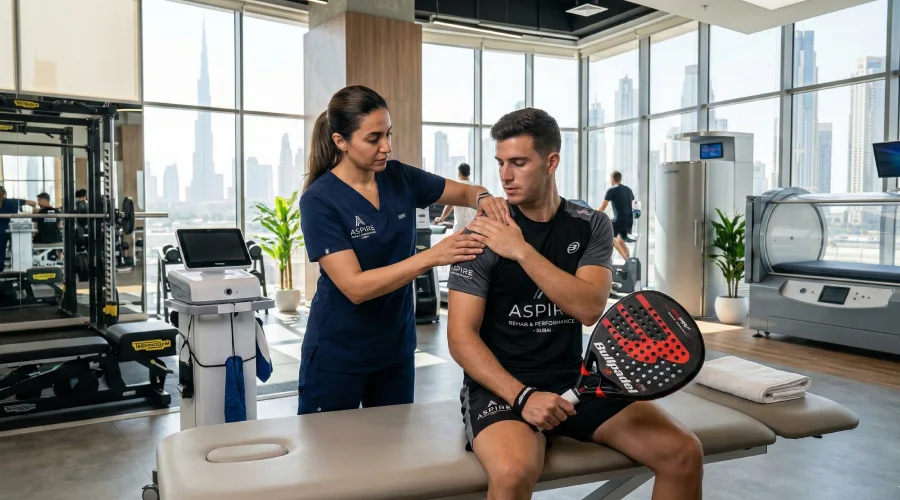
In the heart of Dubai’s sports landscape, Beyond Rehab (B-Rehab) has developed a clinical model that specifically addresses the needs of the modern padel athlete. Located in the Pinnacle Building on Sheikh Zayed Road near Al Quoz, B-Rehab combines elite medical expertise with advanced technology and luxury hospitality. Their approach recognizes that for many padel players, “rest” is not a viable option given the social and fitness stakes involved. Therefore, B-Rehab emphasizes an active recovery model that treats the root cause of pain rather than just the symptoms.
Chiropractic and Spinal Care
The asymmetric nature of padel—where the dominant side is heavily loaded during every stroke—leads to significant postural distortions. B-Rehab’s chiropractic specialists provide precision spinal adjustments to restore alignment and improve nervous system function. This is particularly critical for padel players suffering from “rotational stiffness,” where a restricted thoracic spine forces the shoulder to over-rotate, leading to impingement. By restoring spinal mobility, the practitioner reduces the “shear” load on the lumbar discs during low defensive reaches.
Advanced Physiotherapy and Performance Optimization
Physiotherapy at B-Rehab is not limited to post-injury care; it is integrated into a performance enhancement pathway. Personalized recovery programs are designed to address muscle imbalances identified during initial assessments. For a padel player, this might involve strengthening the scapular stabilizers to support the rotator cuff or improving “landing mechanics” to protect the medial collateral ligament (MCL) during lateral shuffles.
Clinical Dry Needling and Medical Cupping
For chronic muscle tension that does not respond to traditional stretching, B-Rehab utilizes clinical dry needling to target intramuscular trigger points. This technique is highly effective for the “forearm knots” common in padel elbow and the deep gluteal tension that can mimic sciatica. Medical cupping is also employed to boost circulation and accelerate tissue healing by creating a negative pressure environment that pulls fresh, oxygenated blood into stagnant areas of muscle tightness.
Next-Gen Recovery Technology
B-Rehab integrates high-end recovery tools that are typically reserved for professional sports teams:
- Therabody Lymphatic Compression: This pneumatic technology increases circulation and assists in the drainage of metabolic waste (such as lactic acid), which is essential for players who participate in back-to-back tournament days.
- Therabody Smart Goggles: Addressing the “mental load” of competitive padel, these goggles use sensory therapy for stress relief and improved sleep quality, which is when the body does the majority of its tissue repair.
- Red Light Therapy and Reformer Pilates: These modalities are used to promote cellular repair and improve core stability, creating a “bulletproof” foundation for the athlete.
The Environmental Variable: Dubai’s Climate and Equipment Fatigue
The unique environmental conditions of the UAE introduce variables that significantly alter the mechanical behavior of equipment and the physiological state of the player. These factors must be factored into any rehabilitation or prevention strategy.
Heat-Induced Material Fatigue
Dubai’s summer temperatures, which often exceed 45°C, have a direct impact on the EVA (Ethylene-Vinyl Acetate) foam cores of padel rackets. High heat causes the EVA to soften, which increases the “ball output” (the speed at which the ball leaves the racket) but reduces the player’s control. To maintain precision, players often increase their grip intensity—unconsciously “squeezing” the racket harder. This chronic increase in forearm tension is a primary driver of lateral epicondylitis during the summer months. Furthermore, heat increases the internal pressure of padel balls, making them bounce higher and faster, which shortens the reaction time and forces more explosive, and potentially injurious, movements.
Humidity and Surface Traction
Humidity in coastal Dubai can reach 90% during the summer. For outdoor courts, this moisture accumulates on the artificial turf, effectively “lubricating” the sand and drastically reducing traction. This leads to a higher incidence of “slipped” ankle sprains and groin strains as the foot gives way during lateral cutting. For indoor play, maintaining a strict 22–24°C environment is essential not just for comfort, but for keeping the court surface dry and predictable.
| Dubai Seasonal Factor | Impact on Equipment/Surface | Biological/Clinical Consequence |
|---|---|---|
| Extreme Heat (>40°C) | Softens EVA foam core | Increased forearm tension; chronic epicondylitis risk |
| High Humidity (>70%) | Moisture accumulation on turf | Traction loss; increased ankle/knee sprain risk |
| Humidity/Sweat | Overgrips lose tackiness | Increased “grip force” requirement; elbow strain |
| UV Radiation | Degradation of turf fibers | Inconsistent ball bounce; increased tripping hazards |
| Thermal Expansion | Ball internal pressure increases | Faster game speed; reduced reaction time for joints |
Advanced Diagnostics in Dubai Sports Medicine
The rehabilitation of padel athletes in Dubai is supported by a diagnostic infrastructure that rivals global sports centers. Leading clinics utilize high-tech assessments to ensure that the return-to-play journey is based on objective data rather than subjective feel.
3D Motion and Kinematic Analysis
Some elite centers in Dubai utilize 3D motion analysis to evaluate the “split-step” and lateral shuffle mechanics. By using high-speed cameras and force plates, clinicians can detect if a player has a “dominant leg bias” or if they are exhibiting excessive knee valgus during landing. This information is used to design “prehab” circuits that correct movement patterns before they result in a meniscal tear or ACL injury.
Musculoskeletal Ultrasound Imaging
Real-time ultrasound has become the “stethoscope” of the sports physio. It allows for the immediate visualization of tendon thickening, paratenon inflammation, or muscle fiber disruption. At clinics like B-Rehab, these visuals help the patient understand their injury, which improves compliance with rehabilitation protocols. It is also essential for guiding precision therapies like PRP (Platelet-Rich Plasma) injections directly into the site of a partial supraspinatus tear.
3D Posture and Foot Pressure Mapping
Correcting the “foundation” is critical for managing chronic lower back and hip pain. 3D posture assessments examine the anatomical lengths and joint angles that are often distorted by the asymmetric loading of racket sports. Wireless in-sole sensors are also used to measure foot pressure distribution during actual play, which informs the creation of custom orthotics to reduce the load on the plantar fascia and Achilles tendon.
Integrative Rehabilitation Modalities in the UAE
Beyond the primary care at B-Rehab, the Dubai ecosystem offers a range of advanced modalities that are frequently integrated into a padel player’s recovery journey.
Extracorporeal Shockwave Therapy (ESWT)
Shockwave therapy is widely regarded as the “gold standard” for chronic tendinopathy in Dubai. High-energy acoustic waves are delivered to the injured tissue, which stimulates blood flow and triggers a healing response in areas with poor natural blood supply, such as the Achilles or the common extensor tendon. Most patients require 3 to 6 weekly sessions, and it is often the “breakthrough” treatment for players who have struggled with “padel elbow” for months.
TECAR and Electromagnetic Therapies
TECAR (Transfer of Energy Capacitive and Resistive) therapy is a radiofrequency modality that generates deep thermal heat. This is used to reduce inflammation and muscle stiffness in the deep layers of the back and hips. Unlike superficial heat packs, TECAR reaches the core of the muscle, making it highly effective for “muscle overloads” seen in competitive athletes.
Regenerative Medicine: PRP and Stem Cells
For players with persistent injuries that fail to respond to conservative therapy, regenerative treatments like PRP are increasingly common. By concentrating the patient’s own growth factors and injecting them into the injured site, clinicians can accelerate the repair of tendons and ligaments. This is a common path for high-level players in Dubai who are looking to avoid surgical intervention for conditions like rotator cuff tears.
Clinical Return-to-Play (RTP) Protocols for Padel
The transition from the clinical environment back to the competitive court is a high-risk period. Dubai’s sports clinics use structured, criteria-based protocols to ensure the athlete is ready for the multi-directional demands of the sport.
The 6-Stage Return-to-Play Progression
- Symptom Resolution: The athlete is pain-free during daily activities and has regained full range of motion.
- Light Aerobic Loading: Low-impact activities (cycling or walking) to increase systemic circulation without joint stress.
- Moderate Sport-Specific Loading: Introduction of linear jogging and moderate-intensity bodyweight exercises (squats, lunges).
- Heavy Non-Contact Activity: Introduction of lateral shuffling, split-steps, and shadow-swinging (hitting without a ball) to test the kinetic chain.
- Controlled Court Practice: Returning to the court for low-intensity hitting with a coach. Focus on technique and “soft” contact.
- Full Competition: Return to match play only after the athlete can reach 85% of their maximum heart rate during training without symptom recurrence.
| RTP Stage | Activity Level | Goal | Specific Padel Drill |
|---|---|---|---|
| Phase I | Daily Life | Pain-free ADLs | Climbing stairs |
| Phase II | Light Aerobic | Increase HR | Stationary cycling |
| Phase III | Moderate | Muscle activation | Lunges with torso twist |
| Phase IV | High Intensity | Lateral agility | Lateral shuffles with split-step |
| Phase V | Practice | Technical re-entry | Volleys and lobs (no smashes) |
| Phase VI | Competition | Match fitness | Full sets with high-intensity lobs |
Prevention and “Prehab” Strategies for the Maturing Dubai Player
As the padel community in Dubai matures, the focus has shifted from “rehab” to “prehab.” Players are beginning to understand that staying on the court requires a proactive approach to body maintenance.
The 6-Minute Padel-Specific Warm-Up
Inadequate warm-ups are the primary cause of lower-limb injuries at the start of matches. A focused 6-minute routine is now standard practice for those looking to avoid “tennis leg” and ankle sprains:
- 0-2 Minutes (Activation): Light jogging, high knees, and butt kicks to increase core temperature.
- 2-4 Minutes (Mobility): Walking lunges with a reach, hip circles, and “cat-camel” stretches for spinal mobility.
- 4-6 Minutes (Neuromuscular Activation): Rapid split-steps, shadow swinging, and short sprints to “wake up” the nervous system.
Strength and Conditioning Focus
For the 35+ age group, which is highly active in the Dubai scene, resistance training is non-negotiable. Bulletproofing the body involves:
- Rotator Cuff: Band-resisted internal and external rotations to stabilize the shoulder during the vibora.
- Core Stability: Pallof presses and planks to manage the rotational torque applied to the lumbar spine.
- Posterior Chain: Romanian deadlifts and calf raises (both straight and bent knee) to prepare the Achilles for explosive starts.
Equipment Optimization
The choice of gear is a clinical decision. Players with a history of elbow pain are advised to move away from “head-heavy” rackets and toward models with a “soft” EVA core and round head shape, which provides a larger sweet spot and better vibration absorption. Similarly, using fresh overgrips in Dubai’s humidity ensures that the hand does not slip, preventing the “death grip” that leads to muscle fatigue.
The Economic Landscape of Padel Health in Dubai
Maintaining peak performance in Dubai’s high-volume padel scene requires a financial commitment that mirrors the premium nature of the sport. Clubs and clinics offer various tiers of service, from community-based play to elite medical support.
| Service Category | Typical Rate (AED) | Unit/Duration | Market Tier |
|---|---|---|---|
| Indoor Peak Court Booking | 280 – 450 | 90 Minutes | Premium (e.g., Redline, ISD) |
| Outdoor Peak Court Booking | 150 – 280 | 90 Minutes | Mid-Range (e.g., Al Quoz locations) |
| Private Coaching (1-on-1) | 330 – 395 | 60 Minutes | Professional Grade |
| Group Session (4 Players) | 120 – 150 | Per Person/Hour | Community Standard |
| Annual Membership | 4,000 | Per Year | Elite Lifestyle |
| Specialist Physio Session | 400 – 600 | 60 Minutes | Clinical Expertise (e.g., B-Rehab) |
| Recovery Tech Session | 150 – 300 | 30 Minutes | High-Performance (e.g., Therabody) |
Venues like the Matcha Club have redefined padel as a boutique wellness experience, integrating yoga and cafe culture to attract health-conscious players. Meanwhile, specialized clinics like Beyond Rehab (B-Rehab) serve as the “pit stop” for these athletes, ensuring their bodies can handle the demands of a high-performance lifestyle.
Psychological and Social Dimensions of Injury
A neglected aspect of padel rehabilitation in Dubai is the psychological impact of injury. Because the sport is so deeply social, being “off the court” often means being “out of the loop.” This can lead to a sense of isolation among expats who rely on padel for their social circle. Clinicians in Dubai are increasingly aware of this, incorporating social elements into the rehab process or encouraging light activity within the club environment to maintain the athlete’s connection to their community.
The story of athletes like Ahmed, who plays at a high level despite having leg prosthetics, serves as a powerful inspiration for the community. It highlights the resilience of the padel population and the critical role that specialized rehabilitation plays in making the sport accessible to everyone, regardless of physical challenges.
Conclusion: Future Outlook for Padel Rehabilitation in Dubai
The future of padel in the UAE is defined by a maturing ecosystem where health, technology, and performance intersect. The shift toward specialized recovery centers like Beyond Rehab (B-Rehab) indicates that the Dubai player is no longer satisfied with general healthcare; they demand elite-level sports medicine that understands the technical nuances of the sport.
As the sport continues its global expansion, Dubai will likely remain a testing ground for innovative recovery technologies. The integration of AI-driven biomechanical analysis, regenerative medicine, and next-generation recovery tools like lymphatic compression will ensure that the “padel boom” is sustainable in the long term. Ultimately, the longevity of the sport in the region depends on a balanced approach—one that respects the biological limits of the human body while leveraging world-class medical infrastructure to keep players healthy, social, and competitive. For the Dubai-based player, the journey from injury back to the court is no longer a period of “rest,” but a high-tech evolution of their athletic potential.