

Medical Disclaimer: The information provided in this article is for educational and informational purposes only. This content is by no means a substitute for professional medical advice, diagnosis, or treatment from a physician or qualified healthcare provider. If you have questions about your health condition, always consult with your doctor or another qualified specialist. Never disregard professional medical advice or delay in seeking it because of something you have read here.
Introduction: Why Do Your Left Neck and Shoulder Hurt at the Same Time?
Experiencing simultaneous pain in the left neck and shoulder can be very concerning. The first thought that might cross your mind, especially due to the involvement of the left side of the body, is a worry about more serious issues like heart problems.
Understanding this pain helps us liken it to an “alarm bell.” In most cases, this alarm is merely a warning for a minor, manageable problem, such as a muscle strain from sleeping incorrectly or sitting at a computer for too long. But in rare cases, this alarm might indicate a real “fire” and an emergency situation that requires immediate action.
The purpose of this comprehensive guide is to help you understand the difference between these two states. Anatomically, the neck and shoulder are very closely related. A complex network of nerves and muscles, such as the Trapezius and Sternocleidomastoid muscles, extends from the cervical spine to the shoulder. For this reason, an injury or tension in one area can easily cause pain in the other, and experiencing pain in both places at the same time is quite common.
This article will explore the common causes, causes stemming from nerve pressure, and most importantly, the dangerous symptoms that should not be ignored. We will also provide practical solutions for relief at home and prevention of its recurrence.
Common and Everyday Causes: “The Usual Suspects”
In most cases, left neck and shoulder pain stems from musculoskeletal problems and our daily habits. These reasons, although annoying, are not usually dangerous and respond well to home treatments. For persistent issues, Physical Therapy for Neck Pain is often a key part of recovery.
Muscle Strain (The Most Common Cause)
This is the most common culprit for left neck and shoulder pain. The muscles in this area can become strained, suffer microscopic tears, or go into spasm for various reasons:
- Static Posture: Maintaining a fixed position for a long time, such as hunching over a computer or smartphone for hours, puts a lot of pressure on the neck and shoulder muscles.
- Chronic Repetitive Movements: Overuse of muscles in occupational or sports activities can lead to chronic fatigue and strain.
- Acute Injury: A sudden movement, like a fall, improperly lifting a heavy object, or a minor accident, can instantly cause muscle strain.
- Minor Activities: Even simple things like reading in bed or grinding your teeth (Bruxism) at night can put pressure on the neck muscles.
Key Symptoms of a Strain: Pain from a muscle strain usually worsens with neck or shoulder movement and improves with rest. This pain may be accompanied by neck stiffness, headaches (especially at the back of the head), or even a mild tingling sensation in the arm.
Poor Posture and “Tech Neck”
In today’s world, “tech neck” has become a silent epidemic. The mechanism of this condition is simple yet destructive. Experts at the Cleveland Clinic use a great analogy: your head is like a heavy “bowling ball.”
When your head is positioned directly over your shoulders, the spine easily supports its weight. But research shows that for every inch (about 2.5 cm) you tilt your head forward, the weight exerted on your cervical spine nearly doubles.
The main problem is the “cumulative effect” of this posture. Spending short minutes in this position isn’t a problem, but research indicates that people spend an average of 4.5 hours a day looking at their smartphones. This constant, cumulative pressure causes muscle spasms, fatigue, and in the long run, disc degeneration and the early onset of arthritis in the neck vertebrae.
Improper Sleep
Your sleeping position plays a direct role in the health of your neck and shoulders. Sleeping on your stomach (prone position) is considered one of the worst positions, as it forces your neck to remain in a 90-degree rotation for hours. Furthermore, using a pillow that is too high or too low throws the cervical spine out of its natural alignment, causing you to start the morning with pain and stiffness.
Stress and Psychological Tension
The mind and body are closely interconnected. When people are under chronic psychological stress, they subconsciously clench their muscles, especially the neck and shoulder muscles (like the upper trapezius). This chronic contraction reduces blood flow to the muscles, leading to pain, stiffness, and the creation of Trigger Points.
Arthritis and Neck Joint Degeneration (Cervical Spondylosis)
Like other joints in the body, the joints of the cervical spine also experience wear and tear with age. This degenerative process, called cervical spondylosis or neck arthritis, can cause chronic pain and stiffness. Sometimes, the body reacts to this degeneration by forming small bony growths called “bone spurs.” These bone spurs can narrow the space available for nerves, setting the stage for more serious problems, which we will discuss in the next section.
These common causes often create a “vicious cycle.” It works like this: poor posture at work causes initial muscle pain. Stress from work or worry about the pain itself causes further muscle contraction. This pain and tension disrupt night sleep. Inadequate sleep lowers the pain threshold the next day and makes the muscles tighter. Understanding this cycle helps us understand why pain sometimes becomes chronic and why its treatment requires a multi-faceted approach (including posture correction, stress management, and sleep improvement).
Causes from Nerve Pressure: Shooting Pains
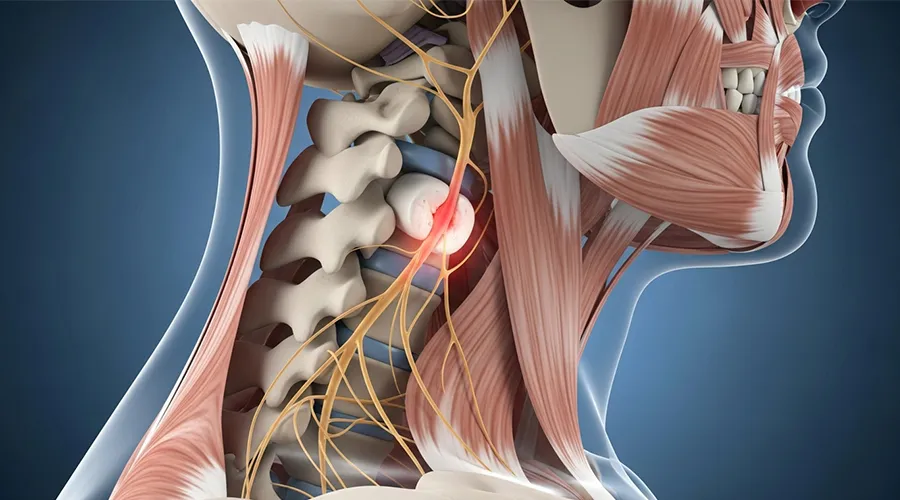
If your pain goes beyond a dull, localized ache and is accompanied by symptoms like “shooting,” “burning,” “numbness,” or “weakness” in the arm and hand, it is likely that a nerve in the neck area is under pressure.
Cervical Radiculopathy (Pinched Nerve)
This is a general (umbrella) term that simply means irritation, inflammation, or compression of a nerve root where it exits the cervical spine. This compression can be caused by soft tissue (like a herniated disc) or hard tissue (like bone spurs from arthritis).
Key Symptoms: Unlike muscle pain, which is usually dull and throbbing, radiculopathy pain is often described as “sharp,” “burning,” or “shooting.” This pain typically starts from the neck and radiates to the shoulder, arm, and sometimes down to the fingers. The accompanying symptoms are very important and include:
- Numbness: Loss of sensation in parts of the arm or hand.
- Tingling: A sensation of pins and needles or “falling asleep.”
- Muscle Weakness: Difficulty holding objects or weakness in specific arm muscles.
Herniated or Bulging Cervical Disc
The intervertebral discs act like “jelly donuts”; they have a tough outer layer (Annulus) and a soft, gel-like inner core (Nucleus). A herniated disc occurs when, due to degeneration or sudden injury, the outer layer cracks, and the inner “jelly” protrudes. This extruded jelly-like material directly hits the adjacent nerve root, causing inflammation and severe radiculopathy symptoms (shooting pain, tingling, and weakness).
Cervical Spinal Stenosis
This condition refers to the “narrowing” of the central spinal canal or the side openings (Foramina) from which the nerves exit. This narrowing is often due to age-related degenerative processes, such as the growth of bone spurs, thickening of ligaments, or bulging discs. As the space narrows, the spinal nerves come under pressure, causing radiculopathy symptoms.
Thoracic Outlet Syndrome (TOS)
This is an important differential diagnosis that is often confused with cervical disc problems. In TOS, the compression occurs in a different area: in the narrow space between the collarbone, the first rib, and the neck muscles (at the thoracic outlet).
The critical point about TOS is that in this space, not only the nerves (brachial plexus) but also the blood vessels (subclavian artery and vein) can be compressed. This leads to distinct symptoms:
- Neurogenic Symptoms: Similar to radiculopathy, including pain and tingling in the shoulder, arm, and especially in the little and ring fingers, and weakness in grip strength.
- Vascular Symptoms: These are key symptoms. Compression of the vessels can cause coldness in the fingers or the entire hand, skin color changes (paleness or bruising), swelling in the arm, and a weak pulse in the affected arm.
Paying attention to these details can help you provide very accurate information to your doctor. Think about it: Is your pain dull and localized (likely muscular)? Is it sharp and shooting with tingling (likely cervical radiculopathy)? Or is it accompanied by coldness and color change in the hand (likely TOS)? Also, another diagnostic clue: pain felt more in the back of the shoulder (shoulder blade area) is often related to the neck, while pain concentrated in the front of the shoulder usually relates to the shoulder joint itself (like rotator cuff problems).
Serious Red Flags: When is Left Neck and Shoulder Pain an Emergency?

This is the most important section of this article. Although most left neck and shoulder pain is benign, in rare cases, this pain can be a sign of a life-threatening medical condition.
The key point to remember is this: in these emergency scenarios, “pain” rarely occurs alone. It is the “collection of accompanying symptoms” that should be considered a red flag.
Heart Attack
Since the heart is located on the left side of the chest, pain that radiates to the left arm, shoulder, and neck can be one of the known symptoms of a heart attack.
Look for these accompanying symptoms: If your left neck and shoulder pain occurs suddenly and is accompanied by one or more of the following symptoms, do not wait. Call emergency services (911) immediately.
- Chest Pain or Pressure: A feeling of pressure, heaviness, tightness, or pain in the center of the chest that may come and go.
- Pain Radiation: Pain that radiates from the chest to the jaw, teeth, back, neck, or left arm.
- Shortness of Breath: Difficulty breathing or feeling short of breath.
- Other Symptoms: Sudden cold sweat , nausea or vomiting , severe dizziness or feeling lightheaded and on the verge of fainting.
A vital note for women: Women may experience “atypical” heart attack symptoms. These symptoms might not include chest pain and may instead present as short, sharp pain in the neck or back, severe shortness of breath, nausea, and sudden, extreme fatigue.
Pancoast Tumor (A Type of Lung Cancer)
This is a very rare but serious cause of left shoulder and neck pain. A Pancoast tumor is a type of lung cancer that grows at the upper part (apex) of the lung. Due to its specific location, this tumor, instead of causing respiratory symptoms, puts pressure on the nerves and blood vessels leading to the arm.
Very specific symptoms (Pancoast Syndrome): These symptoms usually worsen progressively over time:
- Severe, persistent pain in the shoulder, shoulder blade (Scapula), and the inner part of the arm.
- Pain that radiates down the arm to the little and ring fingers.
- Progressive weakness in the hand muscles and loss of fine motor skills (like writing or buttoning).
- Significant swelling in the arm or hand.
- Horner Syndrome: A collection of symptoms on the same side of the face, including a drooping eyelid, constricted pupil, and reduced sweating on one side of the face.
- General cancer symptoms like unexplained weight loss and extreme fatigue.
Spinal Cord Injury or Cervical Vertebra Fracture
These conditions almost always occur after a severe trauma such as a car accident, a fall from a height, or a serious sports injury. Severe neck pain after such an incident should always be treated as an emergency.
Nervous warning signs: If neck pain is accompanied by any of the following symptoms, it indicates pressure on the spinal cord and is considered an absolute medical emergency :
- Loss of coordination in the hands (e.g., trouble picking up a coin or buttoning a shirt).
- A feeling of heaviness or progressive weakness in the arms and also the legs.
- Difficulty walking or maintaining balance.
- Loss of bladder or bowel control (urinary or fecal incontinence).
When to See a Doctor (A Clear Decision-Making Guide)

Deciding when to rest, when to see a doctor, and when to call emergency services can be confusing. The following guide provides triage to help you make a decision.
Immediate Action (Call 911 or Go to the ER)
- Chest/Cardiac Symptoms: Pain, pressure, heaviness, or tightness in the chest; shortness of breath; jaw pain; cold sweat; sudden nausea.
- Severe Neurological Symptoms: Sudden loss of coordination (like buttoning a shirt); difficulty walking; loss of bladder or bowel control.
- After Trauma: Severe neck pain or shoulder deformity after an accident, fall, or sports injury.
- Systemic Symptoms: High fever accompanied by severe neck stiffness (inability to touch chin to chest), vomiting, and severe headache.
- Pain Quality: Sudden, severe, and unbearable pain that you have never experienced before.
See a Doctor (Get an appointment as soon as possible)
- Moderate Neurological Symptoms: Progressive heaviness or weakness in the arm; persistent numbness or tingling that is worsening.
- Vascular Symptoms: Coldness, paleness, or bruising of the left hand; arm swelling; weak pulse (possible signs of TOS or a blood clot).
- Systemic Symptoms: Mild fever, unexplained weight loss, extreme fatigue (possible symptoms ).
- Pain Quality: Pain that is progressively worsening, not getting better.
Home Care (And see a doctor if it doesn’t improve)
- Pain Quality: Dull or sharp pain that does not improve with home treatment and lasts for more than one or two weeks.
Home Treatments and Immediate Pain Relief

For common causes (like muscle strain and poor posture), several effective home remedies can help alleviate pain and promote healing.
The Rule of Ice vs. Heat
- Ice (Cold): For the first 48 hours after an acute injury (like a sprain or sports injury), use a cold pack. Wrap the ice in a towel and place it on the painful area for 15 to 20 minutes at a time. Cold helps reduce inflammation and swelling.
- Heat: For chronic pain, muscle stiffness (like tech neck or stress-related pain), heat is the best option. A heating pad, hot water bottle, or a hot shower can increase blood flow to the muscles, relax them, and relieve pain.
- Warning: If the area is visibly swollen, do not use heat, as it can worsen the swelling.
Over-the-Counter (OTC) Medications
Nonsteroidal anti-inflammatory drugs (NSAIDs) like ibuprofen or naproxen can help reduce pain and inflammation. Acetaminophen can also be effective for pain relief.
Gentle and Safe Stretches
The key concept here is “motion is lotion.” Complete rest and prolonged immobility can make muscles stiffer. The goal is to rest from activities that aggravate the pain, not to stop all movement.
Critical Safety Warning: These movements must be very gentle and performed within a pain-free range of motion. If at any point you feel severe pain, shooting pain, or tingling, stop immediately.
- Shoulder Rolls: Gently bring your shoulders up toward your ears, then roll them back, and finally down. Repeat this movement 10 times.
- Neck Side Bend: Gently bring your left ear toward your left shoulder (do not raise your shoulder). Hold for 15 seconds. Return to the center and repeat for the right side.
- Neck Rotation: Gently turn your head to the left, as if you are looking over your left shoulder. Hold for 15 seconds. Return to the center and repeat for the right side.
Stress Management
Since stress directly causes neck muscle contraction , stress management techniques are part of the treatment. Deep breathing exercises (like the 4-7-8 technique: inhale for 4 seconds, hold your breath for 7 seconds, exhale for 8 seconds), short meditation, or mindfulness can help reduce subconscious muscle tension.
Long-Term Prevention: Lifestyle Modification
Relieving pain is the first step; preventing its return is the final step. Prevention almost always focuses on correcting two key factors: workplace ergonomics and sleep posture.
Workplace Ergonomics (Countering “Tech Neck”
Many people think prevention is a “static” adjustment, like buying an expensive chair. While static adjustments are important, the main problem is “staying” in that position for hours on end. Effective prevention is “dynamic” and based on movement.
Static Settings (Setting up your desk): Adjust your workstation based on these principles:
- Monitor: The top of the screen should be at eye level or slightly below it. The monitor’s distance should be about an arm’s length away from you.
- Laptop: Laptops are inherently not ergonomic because their screens are too low. If you use a laptop consistently, be sure to use a laptop stand (to raise the screen) and a separate keyboard and mouse.
- Chair: The chair height should be adjusted so that your feet are flat on the floor and your knees are at a 90-degree angle. Use a chair with proper lumbar support.
- Keyboard and Mouse: The keyboard should be positioned so that when typing, your elbows are at a 90-degree angle and close to your body, and your wrists are straight.
Dynamic Prevention (Movement): This is the most important part of prevention. Experts believe that: “Your best posture is your next posture.”
- The 30-Minute Rule: For every 30 minutes of sitting, stand for at least 30 seconds, stretch, or walk a bit. This gives your muscles a chance to rest and recover and breaks the cumulative effect of the pressure.
Correcting Sleep Posture
Remember these key recommendations for sleep :
- Best Positions: Back-sleeping or side-sleeping.
- Worst Position: Stomach-sleeping. Do your best to break this habit.
- Pillow Choice:
- If you sleep on your back: You need a pillow that fills the curve of your neck but doesn’t push your head forward (memory foam or thinner pillows are suitable).
- If you sleep on your side: You need a thicker pillow to fill the space between your ear and shoulder, keeping your head aligned with your spine