
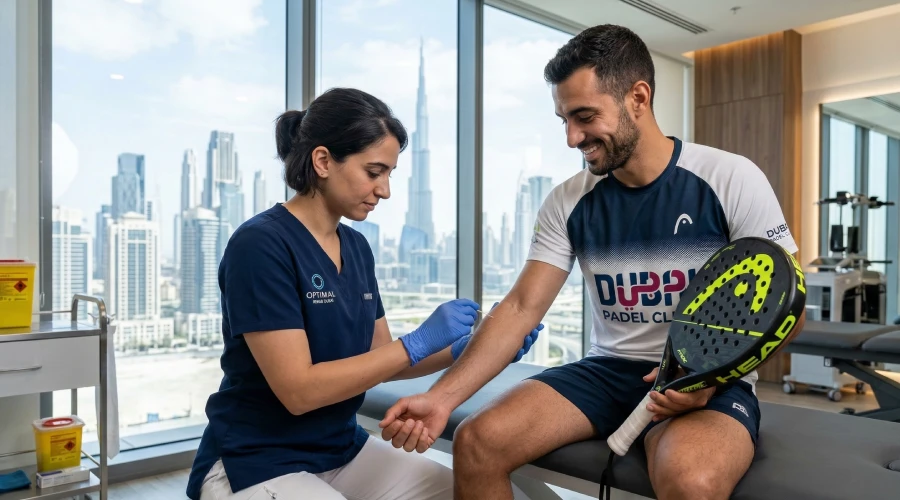
The clinical landscape of sports medicine and musculoskeletal rehabilitation in Dubai has witnessed a transformative shift in recent years, largely driven by a sophisticated healthcare infrastructure and a high-performance athletic culture. While much of the city’s focus has been on lateral elbow strain, medial epicondylitis—colloquially known as golfer’s elbow—has emerged as a significant pathology within the city’s active demographic. This condition encompasses both professional athletes and the expanding community of recreational players who demand rapid, evidence-based recovery.
While the nomenclature suggests a specific association with golf, contemporary clinical data in the United Arab Emirates indicates that the condition is increasingly prevalent among practitioners of padel, tennis, and heavy weightlifting. Individuals seeking specialized physiotherapy in Dubai are often surprised to find that these activities place extreme mechanical demands on the elbow’s medial flexor-pronator mass. The following analysis explores the multifaceted nature of golfer’s elbow, focusing on recovery pathways essential for long-term functional restoration.
Pathomechanics and Biological Etiology of Medial Epicondylitis
Medial epicondylitis is medically defined as a symptomatic chronic degeneration of the tendons that attach the forearm flexor muscles to the medial epicondyle of the humerus. It primarily affects the common flexor tendon origin, specifically involving the pronator teres and the flexor carpi radialis. These muscles are responsible for wrist flexion and forearm pronation—movements that are foundational to most racket sports played in Dubai.
Modern histopathological assessments suggest the condition is more accurately classified as “tendinosis” in chronic cases rather than “tendinitis.” This involves a process of angiofibroblastic hyperplasia, where the body attempts to repair micro-tears with disorganized collagen and dysfunctional neovascularization. In the high-performance environment of the UAE, environmental factors such as humidity (often exceeding 70%) affect equipment grips, leading to a “death grip” (excessive squeeze) that significantly increases tension on the medial flexor group, accelerating tissue breakdown.
Biomechanical Stressors: Distinct from the “Padel Elbow”
The surge in Padel participation has led to a unique clinical profile in Dubai. While lateral pain is a common topic in Padel injury rehabilitation in Dubai, the medial side is increasingly at risk during high-intensity smashes and defensive “low-reaches” where the wrist is forced into extreme flexion.
Unlike tennis, where stringed rackets dissipate energy, the solid EVA core of a Padel racket transmits peak force directly through the wrist and into the medial epicondyle. This mechanical reality is governed by the impulse-momentum relationship, where a shorter contact time results in a higher peak force F:
F = Δp / dt
| Activity | Primary Biomechanical Stressor | Primary Muscle Group Affected |
|---|---|---|
| Padel | Vibration from solid racket; wrist flexion during smashes. | Flexor carpi radialis; Common flexor origin. |
| Golf | Impact with turf; lead arm deceleration. | Pronator teres; Flexor carpi radialis. |
| Tennis | Spin serves; forceful forehand follow-through. | Wrist flexors and pronators. |
| Corporate | Static load; repetitive micro-movements during typing. | Longus muscles of the forearm. |
Clinical Manifestations and Diagnostic Protocols
The diagnostic process in Dubai’s leading sports clinics involves a rigorous integration of patient history and physical examination. At B-Rehab, we look for pain localized to the inner aspect of the elbow that may radiate down the volar surface of the forearm toward the wrist.
Differential Diagnosis
- Localized Tenderness: Exquisite tenderness 1–2 cm distal to the medial epicondyle prominence.
- Grip Strength Deficits: Weakness in gripping, often resulting from pain inhibition (pseudo-weakness).
- Neurological Involvement: Approximately 10–15% of cases involve ulnar nerve irritation (cubital tunnel syndrome), leading to numbness in the ring and little fingers.
Leading sports physiotherapists often utilize dynamic ultrasound to observe tendon integrity in real-time, identifying thickening or hypoechoic areas that indicate micro-tears.
Physiotherapy Frameworks: Load-Management Protocols
Successful rehabilitation for golfer’s elbow in Dubai has moved toward a “load-management” framework, recognizing that tendons require specific mechanical stimulus to remodel and heal.
Phase I: Protection and Symptom Modification
The immediate goal is reducing irritability without resorting to total immobilization. During acute flare-ups, clinicians often employ massage therapy or specialized sports massage to address compensatory tension in the forearm and improve local circulation. This phase adheres to the POLICE principle (Protection, Optimal Loading, Ice, Compression, and Elevation).
Phase II: Analgesia and Advanced Interventions
As pain subsides, isometric loading is introduced to induce an analgesic effect. Additionally, modern Dubai clinics utilize dry needling to release myofascial trigger points in the flexor-pronator mass. For those seeking targeted relief, dry needling for the arm has shown significant efficacy in reducing chronic tension and “resetting” the neuromuscular signal to the tendon.
Phase III: Structural Remodeling
The hallmark of recovery is progressive loading. Eccentric exercises, where the muscle lengthens under load, serve as the primary driver for collagen synthesis. This phase is crucial to prevent the recurrence of injuries during high-velocity movements on the court.
The Kinetic Chain and Holistic Alignment
Specialized clinics like Beyond Rehab (B-Rehab) emphasize that golfer’s elbow is rarely an isolated failure of the آرنج. It is often the “canary in the coal mine,” signaling deficiencies in the shoulder or thoracic spine. For instance, a lack of scapular stability forces the elbow to over-compensate during an overhead swing.
In many cases, integrating chiropractic care helps ensure proper spinal alignment, allowing the kinetic chain to function efficiently. This distal-to-proximal approach offloads the medial epicondyle and addresses the root cause of the mechanical overload.
Advanced Recovery Technologies in Dubai
Dubai’s healthcare sector is distinguished by its access to high-end recovery technologies that complement traditional physiotherapy exercises:
- Red Light Therapy: Also known as photobiomodulation, it interacts with mitochondria to enhance cellular ATP production, accelerating the metabolic demands of tendon repair.
- Medical Dry Cupping: Utilizing dry cupping improves micro-circulation and decreases fascial stiffness in the forearm, a common site of stagnation in chronic cases.
- Shockwave Therapy: Delivers acoustic energy to trigger a neo-vascularization response in chronic, stalled tendons that have failed to respond to exercise alone.
Navigating Healthcare and Costs in Dubai
In the Emirate of Dubai, health insurance is mandatory for all residents. Coverage for physiotherapy is standard in most “Enhanced Plans,” which typically cover 15 to 20 sessions per year, often requiring a referral from a licensed GP or orthopedic specialist.
| Service Type | Average Cost (AED) |
|---|---|
| Initial Assessment | 300 – 600 |
| Physiotherapy Session | 200 – 700 |
| Specialized Modality (Shockwave/Laser) | +150 – 300 |
Conclusion: Achieving Long-Term Resilience
The management of medial epicondylitis in Dubai blends manual expertise with biomechanical precision. By addressing the root causes—whether they lie in equipment choice, kinetic chain imbalances, or workplace ergonomics—patients can achieve long-term athletic longevity. At B-Rehab, success is defined by a commitment to the rehabilitation process and the adoption of a proactive “prehab” lifestyle, ensuring you stay active in Dubai’s vibrant sports community.
Would you like me to develop a specific “Return-to-Play” exercise chart for your patients, or perhaps create a social media summary of this article to drive traffic to your clinic?